Guides · Sky tonight
What is that moving light in the sky?
A steady, non-blinking light gliding smoothly across the night sky — no flashing, no sound — is almost always a satellite catching sunlight. The brightest is usually the International Space Station. A straight line of evenly-spaced lights is a Starlink train. Blinking or coloured lights are aircraft; a quick streak gone in a second is a meteor. Here's how to tell them apart in ten seconds — and identify the exact satellite overhead right now.
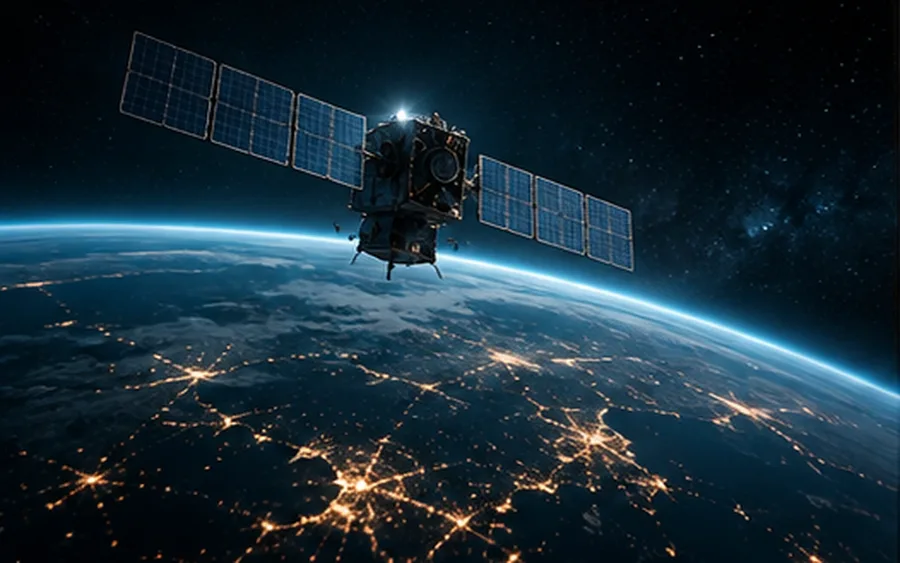
🛰️ Identify what's above you right now →
⏱️The 10-second test: steady or blinking?
You can classify almost any moving light in about ten seconds. Watch it and ask:
- Does it blink or flash? If it flashes — especially red and green — it's an aircraft or a drone. Satellites do not blink.
- Is the light steady and white? A single, steady, white point that glides in a smooth straight line is a satellite reflecting the Sun.
- Does it make any sound? Satellites are silent. Engine noise means it's a plane.
- How long is it visible? A satellite crosses the sky over 2–5 minutes and often fades out mid-sky as it enters Earth's shadow. A meteor is a bright streak gone in under a second.
🛰️A straight line of lights = a Starlink train
If you see a string of evenly-spaced lights, one after another following the same path, that's a Starlink train — a batch of SpaceX internet satellites recently launched, before they climb and spread into their operating orbits. It's one of the most-reported "UFO" sights of the last few years, and it's completely explainable.
Starlink trains are brightest in the first few nights after a launch, shortly after dusk or before dawn. Once the satellites spread out (within days), they become individual faint dots. See how to catch a Starlink train tonight →
🔭Satellite vs aircraft vs meteor vs planet
Here's the full cheat-sheet for every kind of light people mistake:
| What you see | Motion | Blinking? | Sound | Duration |
|---|---|---|---|---|
| Satellite | Smooth straight glide | No — steady white | Silent | 2–5 min, often fades out |
| ISS | Smooth, very bright, fast | No — steady, brightest of all | Silent | 2–5 min horizon to horizon |
| Starlink train | A line of dots, same path | No — steady | Silent | Several minutes |
| Aircraft | Straight or turning | Yes — red/green flashing | Often audible | Minutes; sound gives it away |
| Drone | Hovers, changes direction | Yes — coloured, erratic | Buzzing up close | Variable, can hover |
| Meteor | Fast streak, one direction | No | Silent | Under 1 second |
| Planet / bright star | Doesn't move (rises slowly) | Twinkles (stars), not planets | Silent | All night |
The two most common confusions: a planet (Venus, Jupiter) looks like a bright steady light but doesn't travel across the sky in minutes — it barely moves. And a satellite flare (a sudden brief brightening as a flat surface catches the Sun) can look dramatic but still follows a straight satellite path.
🎯How to identify the exact satellite overhead
Once you know it's a satellite, you can find out which one. Open the SkyLens live tracker — it plots every object in the public CelesTrak catalog in real time on a 3D globe. Enter your location or use the "What's above me?" view to see the named satellites passing over you right now — Starlink, the ISS, weather, navigation and science satellites — each with its altitude, speed and pass direction.
Step-by-step: what satellite is that? → · Is that the ISS? Get tonight's pass times →
🌇Best time and conditions to look
Satellites are visible when it's dark for you on the ground but the satellite overhead is still lit by the Sun. That means:
- 1–2 hours after sunset or before sunrise — the prime windows.
- A clear sky away from bright city lights helps, but the ISS and bright satellites are visible even from cities.
- Look for movement — your eye catches a steadily-gliding point more easily than a fixed star.
❓Frequently asked questions
What is the moving light in the sky that is not blinking?
A steady, non-blinking point that glides smoothly in a straight line over a few minutes, makes no sound, and often fades out mid-sky is a satellite reflecting sunlight — most often the ISS. If it blinks, it's an aircraft.
How can I tell a satellite from an airplane?
Satellites are a single steady white light, no flashing, no sound, smooth straight path. Airplanes flash red/green, usually show multiple lights, and are often audible. Blinking = plane; steady glide that fades = satellite.
What are the string of lights moving across the sky?
A straight line of evenly-spaced lights is a Starlink train — recently-launched SpaceX satellites before they spread into orbit. Brightest in the first nights after a launch, around dusk or dawn.
Can I see satellites every night?
Yes, on any clear night. Over 16,000 objects are tracked; dozens are visible to the naked eye in the 1–2 hours after sunset and before sunrise. No equipment needed.
How do I know which satellite I'm looking at?
Use the SkyLens live tracker — it shows every object in the CelesTrak catalog in real time, so you can match the light overhead to a named satellite with its altitude, speed and direction.
Is a moving light in the sky a UFO?
Almost never. The overwhelming majority of "UFO" sightings of moving lights are satellites, the ISS, Starlink trains, aircraft, drones, planets or meteors — all identifiable. Genuinely unidentified cases are rare; a live satellite tracker rules out the ordinary explanations in seconds.
Satellite positions on SkyLens come from the public CelesTrak TLE/GP catalog, refreshed daily and propagated with SGP4; near-Earth object data from NASA/JPL. Independent educational platform — not affiliated with any government agency.