The Moon · Sky tonight
See the ISS cross the Moon
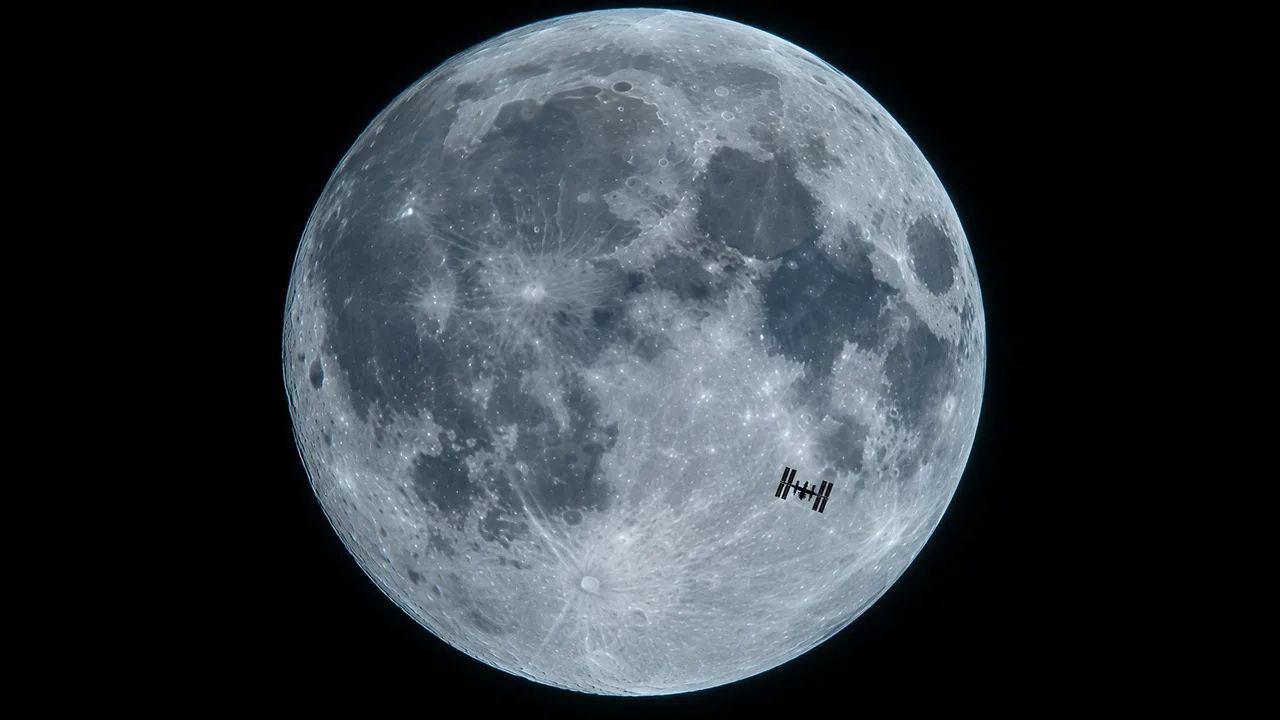
An ISS lunar transit is the International Space Station passing directly in front of the Moon — a tiny dark silhouette that races across its face in under a second. It's one of the most striking things you can catch in the night sky, it's completely predictable, and no — that fast black dot on the Moon isn't a UFO. Here's what it is, how to catch one over your location, and how to photograph it.
🛰️ Track the ISS over your location →
🌙What an ISS lunar transit actually is
The Moon is about 384,000 km away; the ISS orbits just ~400 km up. When the station passes directly on the line between your eye and the Moon, you see it in silhouette — a sharp little dark shape (you can often make out the solar panels) sliding across the bright lunar disc. Because the ISS is moving at roughly 28,000 km/h, the whole crossing is over in about half a second. Blink and you miss it.
✅How to catch one — step by step
- Find a transit near you. Use a transit predictor (search "ISS transit finder") — it maps the narrow ground path where the silhouette is visible, usually only a few kilometres wide.
- Confirm the ISS pass with a live tracker. Open the SkyLens tracker to see where the station is and when it's overhead — handy for lining up the timing.
- Get inside the path. You often need to drive a short distance to stand on the exact line. A few hundred metres off and you'll miss the silhouette.
- Set up on the Moon early. Point binoculars or a telescope (or a telephoto lens) at the Moon minutes ahead — the Moon needs no filter.
- Record continuously. Shoot high-frame-rate video or a fast burst starting several seconds before the predicted time — then find the silhouette frame by frame. Timing to the second is everything.
📸Photographing the transit
A telephoto lens (300 mm+) or a small telescope, a fast shutter (1/1000 s or faster), and burst/high-fps video are the winning combo. The ISS is only a few arc-minutes across against the Moon, so you're relying on precise timing, not luck. The most reliable method: film the whole Moon at 60–120 fps for ten seconds around the predicted time, then scrub through for the two or three frames that catch the station.
Prefer the naked-eye experience? You'll more easily see the ISS as a bright steady light passing near the Moon on many nights — here's how to catch a normal ISS pass tonight.
❓Frequently asked questions
What is an ISS lunar transit?
The ISS passing directly between you and the Moon, appearing as a small dark silhouette crossing the Moon's face. At ~28,000 km/h it lasts only 0.5–1 second.
How often can I see the ISS cross the Moon?
Transits happen often somewhere on Earth, but the visible path is only a few km wide, so from a fixed spot they're rare — often months apart. You usually travel a short way to stand in the path.
Can I see it with the naked eye?
Barely — it's fast and small. Most people use binoculars, a telescope, or high-frame-rate video and find the silhouette frame by frame.
Is the black dot crossing the Moon a UFO?
No — a fast, dark dot crossing the Moon in under a second is the ISS or another large satellite in silhouette. It's predictable and trackable.
How do I photograph an ISS lunar transit?
Set up on the Moon early, use a telephoto/telescope with a fast shutter (1/1000s+) and burst or high-fps video, and start recording several seconds before the predicted second.
ISS position on SkyLens comes from the public CelesTrak catalog, propagated with SGP4. Independent educational platform — not affiliated with any government agency.