The Moon · Space history
Everything humans have left on the Moon
Across every mission, humans have left roughly 200 tonnes of material on the Moon — 6 flags (now bleached white by the Sun), 3 rovers, laser reflectors that scientists still use today, 2 golf balls, a falcon feather, a family photo, a tiny memorial to fallen astronauts — and about 96 bags of waste. Here's the full list of what we left behind, and why some of it still matters.
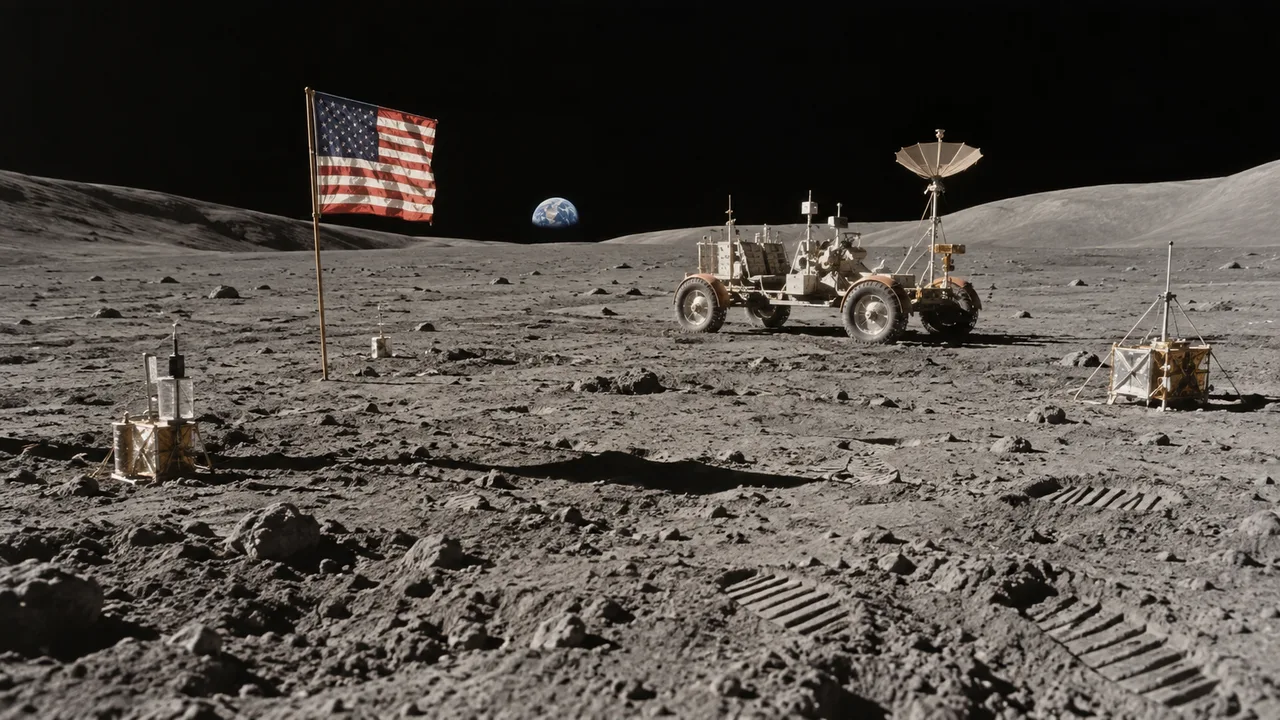
🚩The full list of what we left
| Item | Mission(s) | The story |
|---|---|---|
| 6 American flags | Apollo 11–17 | Five likely still standing; all almost certainly bleached white by decades of unfiltered UV. |
| Laser retroreflectors | Apollo 11/14/15, Lunokhod 1/2 | Still used — observatories bounce lasers off them to measure the Earth–Moon distance to the millimetre. |
| 3 lunar rovers | Apollo 15/16/17 | The electric "Moon buggies," parked where the crews left them. |
| 2 golf balls | Apollo 14 | Alan Shepard's one-handed swings in 1971 — the only golf ever played off-world. |
| A falcon feather + hammer | Apollo 15 | Dropped together on live TV to prove Galileo right — they hit the ground at the same instant. |
| A family photo | Apollo 16 | Charlie Duke left a photo of his family on the surface. |
| "Fallen Astronaut" + plaque | Apollo 15 | A small aluminium figure and a plaque honouring astronauts and cosmonauts who died. |
| ~96 bags of waste | Apollo | Including human waste — left to save weight for the Moon rocks carried home. |
| Descent stages, tools, cameras | All landings | Landers, experiment packages, sample tools and cameras, all abandoned in place. |
| Crashed & robotic craft | Luna, Ranger, LCROSS, etc. | Dozens of impactors and landers from the US, USSR, China, India, Japan and others. |
🔬Why some of it still matters
Most of it is history sitting in the vacuum. But the retroreflectors are working science instruments to this day: fire a laser at them from Earth, time the return, and you get the Earth–Moon distance to within millimetres. That experiment is exactly how we know the Moon is drifting away from us by about 3.8 cm a year — the length of a fingernail's growth, every year, for billions of years.
🛰️Can you see any of it from Earth?
No telescope on Earth can resolve the flags or rovers — they're far too small at that distance. NASA's Lunar Reconnaissance Orbiter has photographed the landing sites from lunar orbit, showing the descent stages and even the astronauts' tracks. Curious what you can spot overhead tonight? Open the live tracker to see the ISS and thousands of satellites in real time, or learn how to identify any moving light in the sky.
❓Frequently asked questions
How much stuff have humans left on the Moon?
Roughly 200 tonnes across all missions — descent stages, three rovers, instruments, tools and waste from the Apollo, Luna/Lunokhod and later programmes.
Are the American flags still on the Moon?
Five of the six are believed still standing (Apollo 11's likely fell during liftoff), but after decades of UV they've almost certainly bleached white.
Are there really golf balls on the Moon?
Yes — Alan Shepard hit two on Apollo 14 in 1971; both are still there.
Is there human waste on the Moon?
Yes — about 96 bags of waste, including human waste, left to save weight for the returning samples.
Which items are still used today?
The laser retroreflectors — observatories bounce lasers off them to measure the Earth–Moon distance, which is how we know the Moon is receding ~3.8 cm/year.
Based on public NASA and mission records. Independent educational platform — not affiliated with any government agency.