Guides · Sky tonight
How to see the ISS (International Space Station) tonight
The International Space Station is the brightest human-made object in the night sky and is easy to spot with the naked eye — if you look at the right time. The short answer: watch during the 1–2 hours after sunset or before sunrise, look for a bright, steady, non-blinking light gliding across the sky in a few minutes, and use a live tracker to get the exact pass over your location.
🛰️ Open the live tracker — find the ISS over you →
✅How to see the ISS tonight — step by step
- Get tonight's pass times for your location — open the SkyLens live tracker or NASA's Spot the Station.
- Go outside 1–2 hours after sunset (or before sunrise) — the ISS must be sunlit while your sky is already dark.
- Face the direction the pass begins (often the west) at the predicted time.
- Look for a bright, steady, non-blinking white light — brighter than any star, gliding smoothly, no flashing and no sound.
- Watch it cross for 2–5 minutes. It may fade out mid-sky as it enters Earth's shadow. No telescope or binoculars needed.
🛰️What the ISS looks like from the ground
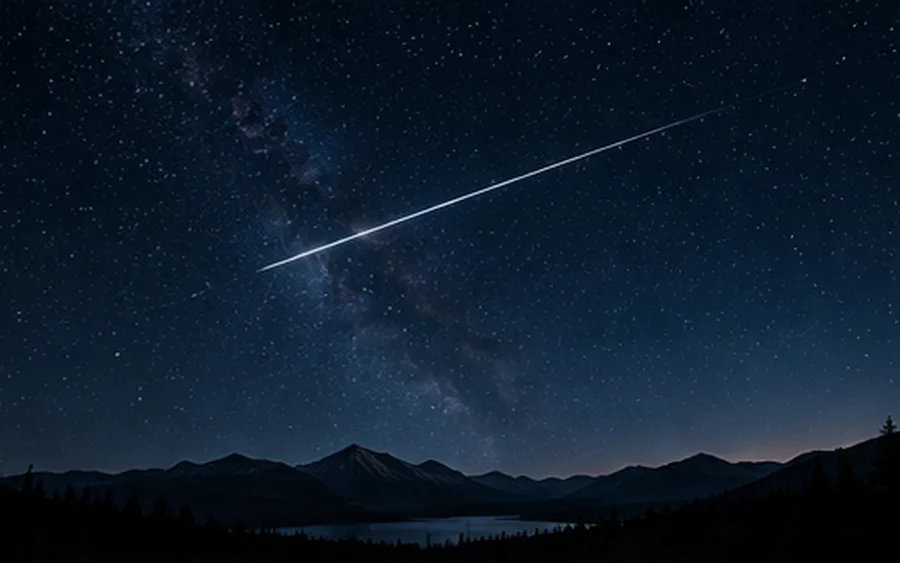
The ISS appears as a very bright white "star" that moves steadily and smoothly across the sky. Unlike an aircraft, it does not blink or flash and makes no sound. It crosses from one horizon toward the other in about 3–5 minutes, then fades out as it passes into Earth's shadow. On a good pass it can outshine every star and planet except the Moon and Venus.
🕐The best time to watch
You can only see the station when it is catching sunlight while your sky is dark — the twilight window in the couple of hours around dawn and dusk. In the middle of the night the ISS passes through Earth's shadow and is invisible; in daylight the sky is too bright. Because it orbits Earth roughly every 90 minutes, several passes can happen on the same night.
🛰️How fast — and how high
The ISS orbits at about 400 km altitude, travelling roughly 28,000 km/h (17,500 mph) and circling the planet every 90 minutes. That speed is why it sweeps across your entire visible sky in only a few minutes rather than drifting slowly like a high-altitude aircraft.
🗺️Find the exact pass over your location
General timing gets you close, but to know precisely when the station crosses your sky you need live positions. The SkyLens live tracker renders the ISS and every other tracked satellite on a real-time 3D globe using the public CelesTrak catalog — set your location and watch the current pass. To understand orbits and visibility windows in depth, see Learn Space.
❓Frequently asked questions
When is the best time to see the ISS?
The twilight window — 1–2 hours after sunset or before sunrise — when it's sunlit against a dark sky. Several passes can happen per night.
What does the ISS look like?
A very bright, steady white light moving smoothly across the sky in 3–5 minutes — no blinking, no sound.
How fast does the ISS move?
About 28,000 km/h (17,500 mph), orbiting Earth every 90 minutes at ~400 km altitude.
Can you see the ISS with the naked eye?
Yes — easily, during a sunlit pass in the twilight window. No equipment needed.
🛰️Explore more
Curious what else is up there? Learn how to see Starlink satellites tonight, track Curious what it's like up there? Read what living on the ISS is actually like. Or track asteroids passing Earth, or open the live tracker.