Deep Space · 2026-09-01
Alpha Centauri Mission: A Private Group Just Announced the Cheapest Probe to Our Nearest Star — and Their 'Great Filter' Warning Is the Most Unsettling Part
A private group just announced they want to launch a probe to Alpha Centauri. The cheapest possible one. The bare minimum that could cross 40 trillion kilometres and come back with data.
And the most chilling thing they said had nothing to do with the cost.
"We could really be facing the great filter."
That one sentence changes everything about how you read this story.
How far away is Alpha Centauri?
Alpha Centauri is 4.37 light-years from Earth — the closest star system to our Sun. That number sounds manageable until you do the maths.
Our fastest spacecraft — travelling at tens of thousands of kilometres per hour — would arrive roughly 75,000 years from now. That's longer than written human language has existed. Three times over.
So when a private group says they want to get there with the cheapest possible mission, they're not minimising the challenge. They're picking the most ambitious target in human history and asking how little it would take.
What exactly is the Alpha Centauri system?
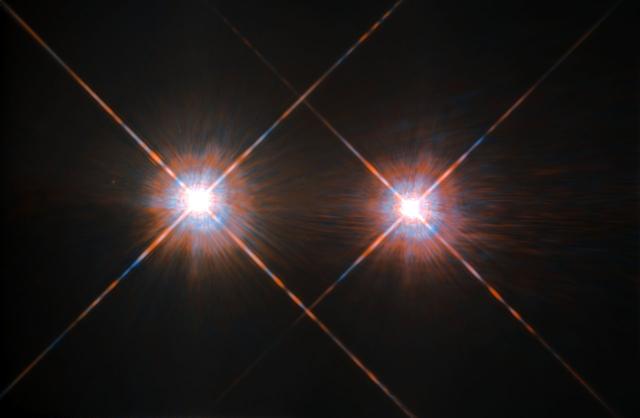
Alpha Centauri isn't one star. It's three.
- Alpha Centauri A — slightly bigger and brighter than our Sun, 4.37 light-years away.
- Alpha Centauri B — slightly smaller and cooler, orbiting A in a tight binary pair.
- Proxima Centauri — a red dwarf 4.24 light-years away, technically the closest single star to Earth. It has a confirmed planet.
Proxima b orbits inside the zone where liquid water could theoretically exist on its surface. It was confirmed in 2016. It's the nearest possible candidate for a world that could host life. We can't see its surface. We don't know if it has an atmosphere. But it is definitively there — and it's only 4.24 light-years away.
What is the Great Filter — and why does it matter?
This is where the announcement gets genuinely unsettling.
The Great Filter is a concept from economist Robin Hanson, posed in 1998 as an answer to the Fermi Paradox. The Fermi Paradox, simply put: the universe is 13.8 billion years old, contains hundreds of billions of galaxies, and even at conservative estimates should be crawling with intelligent civilisations. So where is everybody?
The silence is suspicious. The Filter is the explanation.
Somewhere along the journey from simple chemistry to complex life to space-faring civilisation, something stops almost everything. The question is where that barrier sits.
If the filter is behind us — we got lucky. Intelligent life is so improbable that the universe is mostly empty, and we're the extraordinary exception. Unsettling, but survivable.
If the filter is ahead of us — every civilisation that reaches our level hits something they can't survive. Climate collapse. Self-inflicted extinction. A technology that outpaces wisdom. The silence isn't emptiness. It's a graveyard full of civilisations that made it this far and no further.
How fast would a probe actually need to go?
Breakthrough Starshot — the most-discussed interstellar mission proposal, backed by the late Stephen Hawking — imagined laser-propelled nano-probes travelling at 20% the speed of light. At that velocity, a probe would reach Alpha Centauri in roughly 20 years.
The catch: propelling anything to 20% light speed requires a ground-based laser array of staggering size and cost. Billons of dollars. Infrastructure that doesn't yet exist. A decades-long engineering programme.
The new private group's framing — cheapest possible — suggests something more minimalist. Fewer lasers. Simpler probes. Likely slower travel. Maybe 50 or 100 years in transit instead of 20. Still reaching another star within a human timescale. Still extraordinary.
The specifics of their plan haven't been fully announced. But the intent is clear: design a mission that could actually be funded, built, and launched. Not a concept paper. A real spacecraft.
What would a probe actually find?
Even at Starshot's optimistic 20% light speed, a flyby probe can't slow down — there's no braking system light enough to carry across interstellar space. It would pass through the Alpha Centauri system in minutes. In that window, it might send back:
- Images of Proxima b's surface at close range
- Atmospheric composition readings — the signature chemicals for life or their absence
- Magnetic field data
- Temperature and albedo
That's it. A few gigabytes. After decades of travel.
It would be the most important data ever transmitted to Earth.
Should the great filter worry us?
Honestly? The people who take it most seriously are often also the most motivated to act. The filter isn't an argument for giving up. It's an argument for urgency.
The same species that built nuclear weapons also invented vaccines and reusable rockets. The same civilisation burning fossil fuels also built the James Webb Space Telescope and confirmed an Earth-like planet 4.24 light-years away. We contain multitudes.
Whether the filter is behind us — meaning we're the lucky exception — or ahead — meaning the clock is running — the response is identical: keep going. Build the probe. Cross the distance. Find out if Proxima b has an atmosphere, or an ocean, or a signal.
The universe has been silent for 13.8 billion years. That silence could mean almost anything. And for the first time in history, a small group of people with private funding might be seriously planning to go ask in person.
Want to explore more deep space stories on SkyLens? Or check our UAP files for what we're seeing in our own atmosphere while we're planning missions to the stars. We're still figuring out what's here — and apparently already racing to find out what's there.
SkyLens editorial — live CelesTrak + NASA/JPL data (16106 objects)
Related stories