Deep Space · 2026-08-10
Six Galaxies Are Slowly Tearing Each Other Apart Right Now. NASA Just Published the Photo — and One of Those Stories Is Ours.
Today, NASA published one of the most quietly terrifying images in recent memory.
Not terrifying because it shows a threat. Terrifying because it shows a mirror.
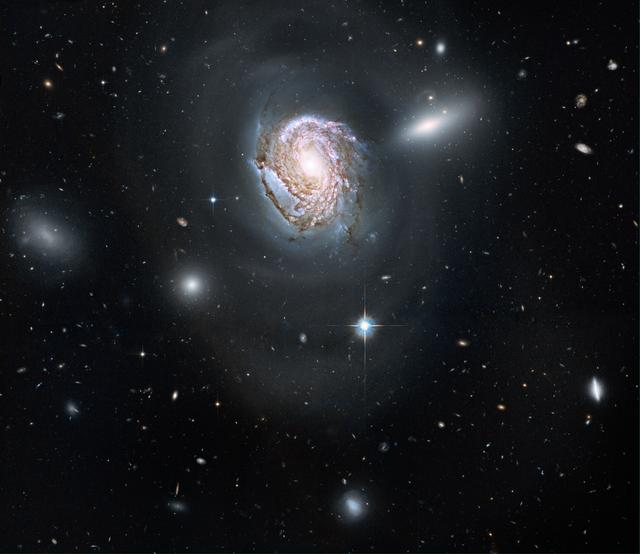
The Astronomy Picture of the Day for August 10, 2026 shows three pairs of galaxies — six entire galaxies, each containing hundreds of billions of stars — all caught in the act of gravitational war. Each pair is at a different stage of a process that takes billions of years to complete. And when you understand what you're actually looking at, it changes how you see the night sky forever.
Because our galaxy is already in one of these dances. The partner has been approaching for billions of years. We just can't see it happening at human speed.
What a Galaxy Collision Actually Is
When most people hear "galaxy collision," they picture an explosion. Two enormous structures slamming into each other in a catastrophic flash of light and fire.
The reality is stranger — and in some ways, more beautiful.
Galaxies are almost entirely empty space. The distances between individual stars are so incomprehensibly vast that when two galaxies pass through each other, almost no stars actually collide. Picture two enormous swarms of fireflies flying directly through each other in the dark. Each firefly misses every other one by kilometers. That's roughly what happens.
What doesn't miss is gravity.
As two galaxies approach, their gravitational fields reach into each other and begin pulling stars off their original paths. Spiral arms get shredded. Long tidal streams of stars — each stream wider than our entire galaxy — get flung out across hundreds of thousands of light-years. Gas clouds slam together and trigger explosions of new star formation so intense astronomers can see them glowing from across the observable universe.
The three galaxy pairs in today's APOD each capture a different chapter of this process. Some are just beginning to feel each other's gravitational pull. Others are deep in a first pass, tidal arms stretching between them like slow-motion waterfalls of light. It's a complete timeline — and it took the universe billions of years to stage it.
You can explore the physics behind gravitational interactions on the SkyLens learn page — or keep reading, because the punchline is personal.
Our Turn Is Already Scheduled
Find a dark sky on a clear night. Look toward the constellation Andromeda. You'll see a faint smudge — barely there, easy to miss. That smudge is the Andromeda Galaxy.
It is heading directly toward us.
Right now. As you read this. It has been approaching for billions of years, and it has not slowed down.
At 110 kilometers per second, Andromeda is currently 2.5 million light-years away. That sounds enormous. It is enormous. But "far away" and "not coming" are very different things. On cosmic timescales, Andromeda is already practically at our door.
The first close encounter happens in roughly 4.5 billion years. The two galaxies will swing through each other, separate, swing back — a second pass a billion years after that. Then a third. And then, after approximately 6 billion years total, they will merge completely into a single massive galaxy.
Astronomers have already named it. They call it Milkomeda.
What Earth's Sky Will Look Like During the Merger
Assume, for the sake of this thought experiment, that Earth is still here. The Sun has about 5 billion years of life left — so the timing is close, cosmically speaking. What would a human being see if they looked up at the sky during the Milkomeda merger?
Nothing familiar.
Right now, the Andromeda Galaxy looks like a faint smudge. During the merger, it would grow until it dominated the sky — a vast glowing structure visible from horizon to horizon, brighter than any star. Two galactic cores would eventually hang in the sky simultaneously: our own center, and Andromeda's center, both visible as blazing regions of dense light.
The new star formation triggered by colliding gas clouds would light up regions that are currently dark. Tidal streams of stars — rivers of suns each hundreds of light-years wide — would arc across the night sky like glowing brushstrokes.
Every constellation humans have ever named would be gone. The bear, the hunter, the scorpion — all dissolved. The sky that human beings have been mapping for 100,000 years would become something no map could prepare you for.
Open the SkyLens live tracker and look at what's orbiting us right now — all those tiny points of light, the satellites we've launched into the space between us and all of this. The scale difference is almost impossible to hold in your mind at the same time.
What Happens to Our Sun?
Here's where it gets personal in a different way.
As the merger progresses, gravitational forces will fling stars into completely new orbits. Our Sun — currently about 26,000 light-years from the galactic center — could end up almost anywhere in the merged galaxy. Computer simulations run by NASA researchers show the Sun has a small but real chance of being gravitationally ejected from Milkomeda entirely, becoming an intergalactic wanderer drifting in the void between galaxy clusters.
No one to know it. No one to see it. Just a star — with its family of planets — crossing billions of light-years of absolute nothing.
The more likely outcome is gentler. The Sun settles somewhere in the outer halo of Milkomeda, far from either original galactic core, surrounded by stars that originated in two different galaxies. An entirely new neighborhood. An entirely different sky.
Why Today's Photo Is a Time Machine
The three galaxy pairs in this morning's APOD aren't just beautiful. They're evidence.
No single observatory can watch a galaxy collision from start to finish — the process takes billions of years. What astronomers do instead is find galaxies at different stages and piece together the timeline. Each pair in today's image is a chapter from a story that takes longer to tell than our Sun has existed.
Studying them is the only way to understand what our own merger will look like. Because no human, no civilization, no species that currently exists will be alive to observe the real thing.
We're watching strangers live through something that's already been decided for us. We just got lucky enough to see the preview.
The Quiet Part at the End
If any of this made you feel small, that's the appropriate response.
But here's the thing that doesn't make the headlines: the individual stars are almost certainly fine. The stars in those colliding galaxies — including any with planets, including any with anything like life — mostly won't notice. They'll be gravitationally nudged into new orbits over millions of years. Their skies will change. Their neighborhoods will change. But the stars themselves? They'll burn on.
Life, if it exists anywhere in those six galaxies, is probably looking up at a sky that is slowly, quietly becoming something new. The same thing that's going to happen to us.
Six billion years from now, in a galaxy that doesn't yet have a name that rolls off the tongue, something might look up at a sky full of stars that used to be two different galaxies — and have absolutely no idea it was ever any other way.
SkyLens editorial — live CelesTrak + NASA/JPL data (16106 objects)
Related stories