Space Discovery · 2026-11-11
NGC 4449: The Dwarf Galaxy Devouring Its Neighbor — and It Shouldn't Be Powerful Enough
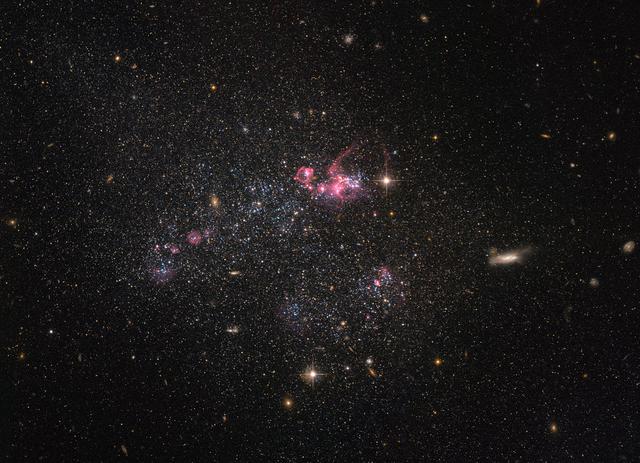
The galaxy NGC 4449 is smaller than one arm of the Milky Way — and it is tearing apart a neighboring galaxy right now. Stars are being ripped loose from their orbits, stretched into a glowing river tens of thousands of light-years long. For over two centuries, astronomers catalogued NGC 4449 and saw nothing unusual. Then an amateur astronomer pointed his backyard telescope at it and noticed something the professionals had missed.
A second galaxy. Being slowly eaten.
What is NGC 4449?
NGC 4449 is a dwarf irregular galaxy in the constellation Canes Venatici — the Hunting Dogs, sitting just below the handle of the Big Dipper. At roughly 20,000 light-years across, it is one-fifth the diameter of the Milky Way and perhaps one-thousandth its mass. It doesn't look like a predator. It looks like a victim.
But NGC 4449 is producing new stars at a rate that rivals galaxies a hundred times its size. It blazes with hot blue stars lighting up enormous gas clouds across its body. Astronomers classify it as a starburst galaxy — a rare category where star formation is running hot and fast, like a furnace left on overdrive. Something is feeding the fire.
As of today, it is NASA's Astronomy Picture of the Day. And the story behind it is stranger than the image lets on.
Who discovered the stellar stream around NGC 4449?
Not a space agency. Not a research telescope. R. Jay GaBany, an amateur astronomer working from a private observatory in California, was gathering deep images of NGC 4449 in 2012 when he noticed something strange at the galaxy's edge. A faint, diffuse trail of stars. Too structured to be noise. Too dim to have shown up in professional surveys that weren't looking for it.
He contacted professional astronomer David Martínez-Delgado at the Max Planck Institute for Astronomy in Heidelberg. What they confirmed, published in the Astrophysical Journal, rewrote a chapter of galaxy science: NGC 4449 is surrounded by a massive stellar stream — the remnant of a smaller companion galaxy being torn apart and slowly swallowed.
It was the first time astronomers had ever caught a dwarf galaxy consuming another dwarf galaxy. The small eating the smaller. Nobody had checked if that was even possible at this scale. It is.
How does a small galaxy eat another galaxy?
Through tidal stripping — the same physics that drives Earth's ocean tides, applied at galactic scale.
When two galaxies approach, gravity doesn't pull them evenly. Stars on the near side of the smaller galaxy feel a stronger tug than stars on the far side. That difference in force — the tidal force — slowly stretches and unravels the smaller galaxy. Its outer stars peel off first, pulled into long streams. Then the inner stars. Eventually the companion dissolves entirely, its stars now orbiting the larger galaxy as a diffuse veil of light.
The textbook assumption was that this only happens when the mass difference is enormous — like the Milky Way consuming a satellite galaxy one-hundredth its size. NGC 4449 showed that it works at every scale. All the way down. The universe has no floor on this behaviour.
Why is NGC 4449 forming stars so fast?
This is the deeper mystery — and the leading answer connects the eating to the fire.
As the companion galaxy fell toward NGC 4449, its gravity disturbed the gas clouds inside the larger galaxy. These gravitational disturbances compressed the gas, pushing regions past the threshold density where gravity wins and new stars collapse. The in-falling companion triggered the starburst. The meal powered the fire.
Blazing blue-white stars — among the hottest and most short-lived in the universe — are erupting across NGC 4449's body right now. They burn at temperatures above 10,000°C and will explode as supernovae within a few million years. Where they die, their shockwaves will trigger the next generation of star formation. The galaxy is consuming one thing and building another at the same time.
Can you see NGC 4449 yourself?
Yes — with a small telescope. Under dark skies, it appears as a faint elongated smudge near Cor Caroli (Alpha Canum Venaticorum), one of the brightest stars in its constellation. With a 10-inch telescope or larger, you can resolve individual star-forming knots inside its body — the same knots that make it blaze brighter than its size should allow. The stellar stream itself is too faint for visual observation; it shows up only in long-exposure photography. But the main galaxy is accessible to any backyard astronomer willing to look.
Use the SkyLens live tracker to find Canes Venatici above your horizon tonight. The tracker shows real-time satellite passes across the same patch of sky — and knowing there's a cosmic cannibal at 12 million light-years behind those satellites changes how the dark between the stars looks.
Where NGC 4449 sits relative to us
What does NGC 4449 tell us about the Milky Way?
More than any textbook could — because our galaxy is running the same program, just at a larger scale.
Right now, the Sagittarius Dwarf Spheroidal Galaxy is being torn apart by the Milky Way's tidal forces. Its stars have been stripped into a stream that wraps around our galaxy multiple times. The Large and Small Magellanic Clouds are being slowly consumed. In approximately 4.5 billion years, the Milky Way and Andromeda will collide. NGC 4449 is what all of that looks like from the outside — the whole sequence compressed into a system small enough to study completely, 12 million light-years away.
It is a mirror. The predator and the stream and the starburst and the slow dissolution of a companion — all of it visible in one photograph, by an amateur with a backyard telescope, in 2012.
The universe has no scale at which the eating stops. It just has smaller and larger versions of the same story. And sometimes the most profound discoveries are made not by billion-dollar observatories, but by someone willing to stare patiently at something old as if seeing it for the first time.
Browse the SkyLens archive for more space stories that break the pattern — or explore the science behind how galaxies grow, merge, and consume each other across cosmic time.
SkyLens editorial — live CelesTrak + NASA/JPL data (15927 objects)
Get the free Night Sky Field Guide
Spot the ISS, Starlink trains and more with the naked eye — plus occasional SkyLens updates.
🔒 No spam. Unsubscribe anytime.
Related stories


