Space Discoveries · 2026-10-05
Sombrero Galaxy: Scientists Found the Remains of the Galaxies It Devoured — and It Rewrites M104's Entire History
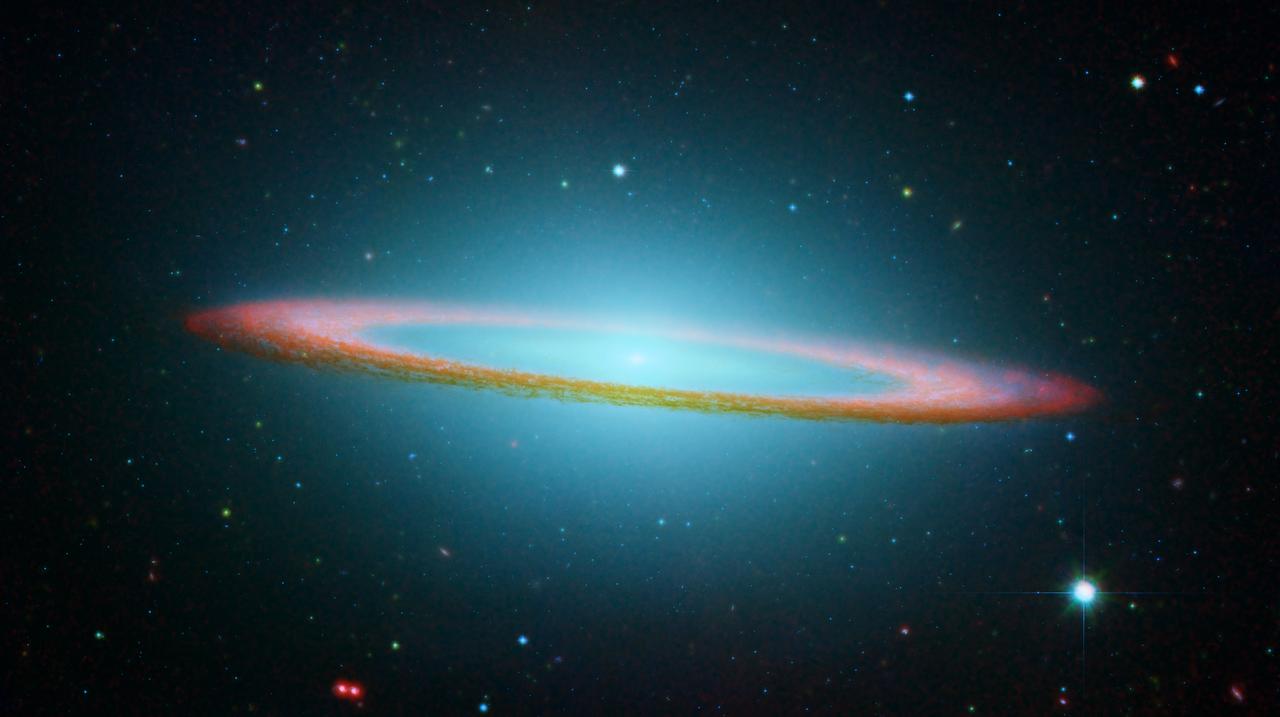
The Sombrero Galaxy looks peaceful. A flat disk. A glowing core. 28 million light-years of quiet, floating in the direction of Virgo. For 240 years, astronomers photographed it, catalogued it, named it after a hat.
But in its outer halo — invisible to earlier instruments — there are ghostly arcs of stars. Stretched thin. Wrapped around the galaxy like pale smoke.
The bones of galaxies M104 consumed billions of years ago.
This isn't a quiet cosmic hat. It's a crime scene.
What is the Sombrero Galaxy?
Officially catalogued as Messier 104, the Sombrero Galaxy sits 28 million light-years away at the edge of the Virgo galaxy cluster. It spans roughly 50,000 light-years — about half the width of our own Milky Way. French astronomer Pierre Méchain spotted it in 1781. For most of the 240 years since, it seemed relatively simple to explain: a lenticular galaxy distinguished by its dramatic dark dust lane and bright central bulge. A photogenic object. A screensaver galaxy.
But M104 always had an anomaly problem. It didn't fit the boxes astronomers tried to put it in. Too bright. Too massive a halo. Too many star clusters. Scientists kept noticing the discrepancies, kept noting them in papers, and kept moving on.
Deep imaging programs are now giving them the answer they kept missing.
How big is the black hole at the center of the Sombrero Galaxy?
The supermassive black hole at M104's core weighs approximately one billion solar masses. For comparison: the black hole at the center of our own Milky Way — Sagittarius A* — weighs about 4 million solar masses.
The Sombrero's central black hole is 250 times more massive than ours.
If Sagittarius A* were the size of a basketball, the Sombrero's black hole would be the size of a house. That's not a rounding error. That's a fundamentally different evolutionary history.
Why does the Sombrero Galaxy have 800 globular clusters?
Globular clusters are ancient, dense balls of stars — hundreds of thousands of stars packed into a sphere just 100 light-years across, orbiting a galaxy's outer halo. Our Milky Way has around 150 of them.
The Sombrero Galaxy has over 800.
Five times the number. From a galaxy half the Milky Way's size. Astronomers counted. They recounted. The number held. For decades, the excess globular clusters sat in papers as an unexplained footnote — anomalous cluster population — and nobody had a satisfying answer.
It was a clue sitting in plain sight. The clue that the Sombrero had a very different past from what its calm appearance suggested.
What are the tidal streams found around M104?
Deep imaging campaigns — using the darkest nights, the longest exposures, the most light-sensitive detectors ever aimed at M104 — have now detected something extraordinary: stellar tidal streams threading through the galaxy's outer halo.
Tidal streams are exactly what they sound like. When a smaller galaxy wanders too close to a massive one, gravity doesn't pull it in as a whole — it stretches it. Like taffy. The near side accelerates faster than the far side. Stars scatter along the orbital path. Over hundreds of millions of years, the smaller galaxy dissolves into an arc of stars, wrapped around the larger galaxy's halo.
M104 has done this. Repeatedly. To multiple galaxies. The streams are the evidence.
This is how the Milky Way grows too. Right now, the Sagittarius Dwarf Galaxy is being stretched into a stream around our own halo. The Magellanic Clouds are slowly being drawn in. M104 is further down the same road — and now we can see it.
Is the Sombrero Galaxy a spiral galaxy or an elliptical?
That quiet argument has been running in astronomy departments for 30 years — and the tidal stream discovery adds a new dimension to it.
At visible wavelengths, M104 looks lenticular: a disk galaxy with no spiral arms. But its outer halo behaves like an elliptical galaxy — smooth, massive, extending far beyond where a lenticular should stop. The tidal streams are further evidence of a violent, merger-rich history more typical of ellipticals than disks.
The current leading hypothesis: M104 is an elliptical galaxy with an embedded disk — a structure that forms only through a specific type of major merger. It's rare. It's unusual. And it's the best single explanation for everything anomalous about the Sombrero.
Where M104 falls in galactic classification:
To be fair: this hypothesis is still being tested. Some astronomers prefer the lenticular classification with modifications. The tidal streams are real — their interpretation is ongoing.
Can you see the Sombrero Galaxy from Earth tonight?
Yes — with minimal equipment. M104 shines at apparent magnitude 8.0, just beyond naked-eye visibility, but clearly visible through any pair of binoculars on a dark night. Point them toward Virgo, near the border with Corvus. You'll find a faint smear of light. That smear is 50,000 light-years wide and contains hundreds of billions of stars.
Here's the part worth sitting with: the light entering your eye right now left M104 28 million years ago. When it departed, there were no humans on Earth. Not even our distant ancestors. Just early primates in African forests, unaware that a galaxy-eating titan was already sending photons in their direction.
The SkyLens live tracker shows exactly where M104 appears in tonight's sky, updated in real time.
How did astronomers detect tidal streams this faint?
Not easily. Tidal streams are extraordinarily dim — their stars are spread across volumes so large that the average surface brightness is 10,000 to 100,000 times fainter than M104's bright core. Detecting them requires long photographic exposures, exceptionally dark skies, and careful digital processing to separate signal from noise.
Deep imaging campaigns over the past decade pushed instrumentation specifically to find these structures in nearby galaxies. M104 was a key target, because if the streams were there, they would explain the anomalous halo and globular cluster count in a single step.
They were there. Today's Astronomy Picture of the Day — released October 5, 2026 — highlights exactly these tidal structures: the Sombrero's hidden history, finally made visible.
Why does the Sombrero Galaxy matter for understanding our own future?
Because the Milky Way is the Sombrero, on a slight time delay.
Our galaxy has consumed dozens of smaller galaxies before now — we can see their stretched stellar streams woven through our own halo. The Sagittarius Dwarf is being absorbed right now. In roughly 4.5 billion years, the Andromeda Galaxy arrives and the real merger begins.
M104 is a model. A completed version of what happens to a galaxy after billions of years of accumulation. Studying it tells us what the Milky Way is becoming.
And what it has already been doing, quietly, all along.
For more on how galaxies form, collide, and evolve — browse the SkyLens space science guides. More stories on the SkyLens blog.
SkyLens editorial — live CelesTrak + NASA/JPL data (15968 objects)
Related stories