Mars Exploration · 2026-08-24
Phobos: The Moon Mars Is Slowly Tearing Apart — Perseverance Just Filmed It Crossing the Sun
Mars has two moons. One of them is being slowly destroyed by the planet it orbits — dragged closer by gravity, centimetre by centimetre, year after year. And on August 12, 2026, NASA's Perseverance rover pointed its camera at the Sun and watched it happen.
This is Phobos. It's roughly 22 kilometres across — about the size of Manhattan Island. It rises in the wrong direction. It's covered in mysterious cracks that scientists now believe are stress fractures from internal tearing. And it has approximately 50 million years left before it ceases to exist.
Why does Phobos rise in the west?
On Mars, the Sun rises in the east — just like on Earth. But Phobos rises in the west. It crosses the Martian sky in roughly four hours and sets in the east — the opposite of every other object in the Martian sky.
The reason is pure physics. Phobos orbits Mars so fast — completing a full lap of the planet in just 7 hours and 39 minutes — that it literally laps Mars's own rotation. The planet hasn't finished one full spin before Phobos has already gone around twice. That's not just unusual. In the entire solar system, only two moons do this. Phobos is one of them.
And that speed is what's killing it.
What are the mysterious grooves on Phobos?
Every good photo of Phobos shows the same thing: its surface is carved with long, parallel scratches — like someone dragged a rake across it. Scientists initially blamed the Stickney Crater impact. That collision was so violent it gouged a crater nearly 9 kilometres wide into a moon only 22 kilometres across. The impact came so close to destroying Phobos entirely that geologists still marvel that anything survived it.
But a darker theory has gained ground. Those grooves might be tidal stress fractures — the surface cracking open under Mars's gravitational pull as the moon is stretched and compressed on every single orbit. If that's right, Phobos isn't just falling toward Mars. It's already starting to break apart from the inside.
What did Perseverance actually capture on Sol 1,948?
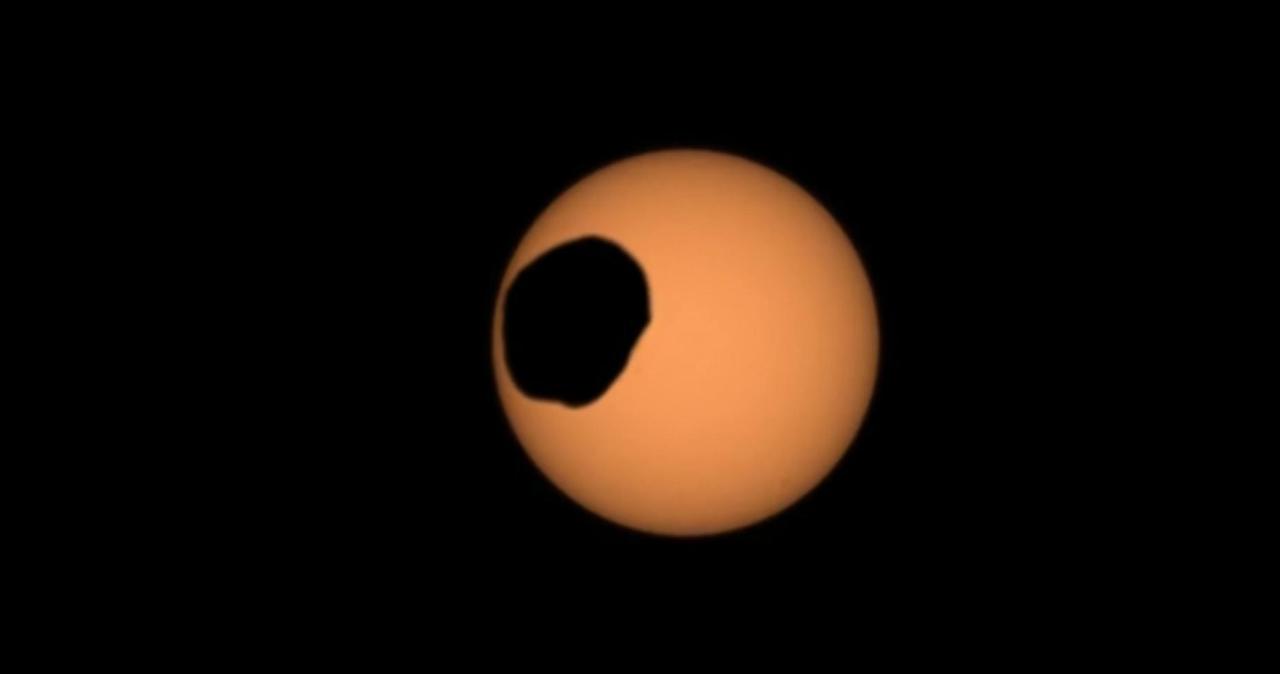
On Sol 1,948 — that's August 12, 2026 in Earth time — NASA's Perseverance rover pointed its Mastcam-Z camera at the Sun and watched Phobos drift across it. The tiny moon appeared as a dark, irregular silhouette transiting the solar disk. Unlike a solar eclipse on Earth, Phobos is far too small to block the Sun completely. From the Martian surface, it looks like a fast-moving potato-shaped shadow crossing a lamp.
The transit lasted roughly 30 seconds. Which sounds completely unremarkable.
It isn't.
Every time a rover precisely measures Phobos's position during a transit, scientists get a sharper fix on the moon's orbital drift — which reveals information about Mars's interior. The way Phobos falls depends on how Mars deforms under its gravitational pull. That deformation depends on what Mars is made of, deep inside, where no drill has ever reached. So filming a 30-second shadow is actually an X-ray of a planet's core. Explore how we study the solar system from the surface on SkyLens's space science guides.
Where did Phobos come from?
Nobody actually knows.
The two main theories are: (1) Phobos is a captured asteroid that strayed too close to Mars billions of years ago, or (2) it formed from debris thrown up when something enormous slammed into the early Mars. The problem is that neither theory fits the data cleanly.
Phobos has a suspiciously low density — about 1.87 grams per cubic centimetre, compared to 3.3 for typical rocky asteroids. That suggests it might be a rubble pile: a loose collection of rock and ice held together by gravity rather than a solid, coherent body. If that's true, it changes everything about what will happen when Mars finally pulls it apart.
Is Phobos going to hit Mars?
In about 50 million years, one of two things will happen — and scientists genuinely don't know which.
If Phobos is a solid body, it will crash into Mars. The impact would carve a crater potentially hundreds of kilometres wide and hurl enough debris into orbit to create a temporary ring system. For the first time in billions of years, Mars would have rings — made of its own destroyed moon.
If it's a rubble pile, tidal forces will pull it apart before it reaches the surface. The fragments would spread into orbit and create a ring of debris that could persist for millions of years before slowly raining down onto the Martian surface as meteorites.
Either way, any future visitor to Mars will look up and see something completely different. The odd little moon that rises in the west — the one Perseverance just filmed — will simply be gone.
How close is Phobos to Mars compared to our Moon?
The footage from Sol 1,948 is already being analysed. Each transit measurement adds to a dataset built across decades — from Opportunity's first grainy transit captures to Perseverance's high-resolution Mastcam-Z imagery. The rover isn't just exploring Mars. It's watching Mars's clock run down on one of the most doomed objects in the solar system, one 30-second shadow at a time.
If this kind of story keeps you up at night, the SkyLens blog has more — from unexplained signals to the moons that might harbour life.
SkyLens editorial — live CelesTrak + NASA/JPL data (16106 objects)
Related stories