Planetary Defense · 2026-08-22
Apophis 2029: The Asteroid Passing Inside Your TV Satellite's Orbit — and What DART Taught Us About Stopping the Next One
On April 13, 2029, a rock wider than the Eiffel Tower is tall will slide between Earth and the satellites showing you Netflix. It will come closer to our planet than any asteroid in recorded human history. No engine. No steering. Pure orbital mechanics deciding where it goes.
This is Apophis. It has a name. We've known about it for twenty years. And in three years, the world will stop and stare at a point of light moving visibly across the daytime sky.
How close is 31,600 km, really?
Your weather satellite — the one providing the map overlays on your phone — orbits at 35,786 km. Apophis will pass inside that ring. The Moon sits 384,400 km away. Apophis comes twelve times closer than the Moon. If Earth had a ring system like Saturn, this asteroid would carve a visible gap through it.
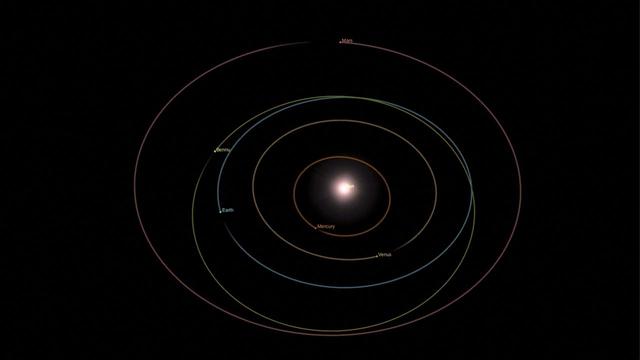
Where Apophis passes relative to Earth
Is Apophis going to hit Earth in 2029?
No. Scientists have ruled out any impact with extremely high confidence for at least the next century. But here's the thing — that wasn't always the case. When astronomers first detected Apophis in June 2004, they gave it a 2.7% chance of striking Earth in 2029. That is the highest impact probability ever formally assigned to a known asteroid of its size. The internet briefly had a quiet, polite breakdown.
More radar observations refined the orbit. The 2029 miss distance is now known to within a few kilometres. Safe. But barely — by the standards of the cosmos, we're talking a near-miss at the atomic scale.
What did the DART mission actually prove?
In September 2022, NASA did something that would have sounded deranged as recently as 2010. They aimed a 570-kilogram spacecraft — roughly the mass of a grand piano — directly at Dimorphos, a 160-metre moonlet orbiting a larger asteroid called Didymos, and rammed it at 6.1 kilometres per second.
It worked. The impact shortened Dimorphos's orbital period by 33 minutes. The mission team expected maybe 10. They got three times that. The rock moved more than predicted because the impact didn't just push the asteroid — it blasted a massive plume of ejecta into space. Like shooting a ball into a pile of sand: the spray carries far more momentum than the bullet. DART confirmed this physics works at real asteroid scale.
However — and this matters — DART worked because it had no deadline. The team spent years planning. The real question isn't whether we can deflect an asteroid. It's whether we'd have enough warning to do it before something finds us that we weren't looking for.
How much warning would we actually get?
This is where it gets uncomfortable.
NASA's planetary defense surveys estimate there are roughly 15,000 near-Earth asteroids larger than 140 metres that we haven't found yet. A 140-metre rock hitting an ocean generates a tsunami capable of devastating coastlines for thousands of kilometres. An Apophis-scale object — 340 metres — hitting a densely populated region would be a regional extinction event. Not a global one. But regional is still millions of people.
To deflect an Apophis-scale threat using DART's kinetic impactor technique, you need years of warning. Five years is tight. Ten years is workable. Six months means you're not launching rockets — you're issuing evacuation orders and hoping the impact zone is mostly ocean.
What would actually happen if scientists detected a real threat today?
Step one: confirm it. Multiple independent observatories track the object. Rule out instrument error. Refine the orbital solution until the probability crosses a threshold that triggers the formal international alert chain.
Step two: politics. The UN's International Asteroid Warning Network (IAWN) and the Space Mission Planning Advisory Group (SMPAG) were created specifically for this scenario. But they're advisory. The actual decision to launch a deflection mission requires sovereign space agencies — NASA, ESA, JAXA, ISRO, potentially others — to agree, fund, design, build, and launch within a shrinking window.
Step three: physics. At very short notice, a kinetic impactor becomes useless — you'd need to move the rock over years, not weeks. The fallback option, explicitly written into NASA's contingency plans, is a nuclear standoff detonation: a warhead detonated near the asteroid's surface to ablate material and push it off course without fragmenting it into a shotgun blast. This is not science fiction. It is the last-resort option in the actual playbook.
Initial orbital calculations suggest a 2.7% impact probability for 2029. The highest ever recorded for an asteroid of this size.
As more data arrives, the probability briefly climbs. Brief but genuine alarm in the planetary science community.
Refined observations eliminate the 2029 impact scenario. The 2036 gravitational keyhole remains a theoretical concern.
Arecibo-era radar data confirms Apophis will miss the keyhole. No impact for at least 100 years.
NASA deliberately changes an asteroid's orbit for the first time in history. The deflection exceeds expectations by 3×.
Closest approach of a named asteroid in recorded history. Visible to the naked eye from parts of Europe, Africa, and Asia. A scientific fleet may be watching from orbit.
Why is the 2029 flyby a once-in-a-generation scientific event?
Every major space agency wants sensors near Apophis during the pass. ESA's Ramses mission is designed to rendezvous with the asteroid before its Earth encounter and document exactly what happens when our planet's gravity deforms a 340-metre rock at close range — tidal stretching, surface changes, reshaping. Nobody has ever watched this happen to a near-Earth asteroid up close. The data will calibrate every planetary defense model we build for the next century.
Because Apophis is the template. The threat that wasn't — but proved the surveillance system works, the orbital math is correct, and the next one might not be so forgiving. Right now, tonight, there are thousands of Apophis-scale objects orbiting the Sun that we haven't catalogued. Some of them are certainly on Earth-crossing paths. We just don't know which ones yet. That's why the sky surveys running 365 nights a year matter more than almost any other scientific infrastructure on Earth.
SkyLens editorial — live CelesTrak + NASA/JPL data (16106 objects)
Related stories