Planetary Defense · 2026-07-26
NASA Hit an Asteroid at 24,000 km/h and Moved It Off Course. That Was the Easy Part.
In September 2022, NASA deliberately crashed a spacecraft into a rock 11 million kilometers away. The rock moved.
For the first time in the 4.5-billion-year history of this planet, one species had actually changed the trajectory of a space object threatening its world.
That's not the surprising part.
The surprising part is what nobody has figured out since.
The Spacecraft That Changed Everything
DART — the Double Asteroid Redirection Test — launched in November 2021 and spent nearly a year coasting toward a binary asteroid system called Didymos. The target was Dimorphos: a 160-meter-wide rock orbiting the larger asteroid like a tiny moon.
At 7:14 PM Eastern time on September 26, 2022, DART hit it dead-center at 24,000 km/h and went silent forever.
Mission scientists predicted the impact would shorten Dimorphos's orbital period by about 10 minutes. They needed 73 seconds to call it a success.
The actual result: 33 minutes. Three times better than expected.
So the physics works. Beautifully, actually. Which means the world's attention has now shifted to the harder problem.
The Asteroid We Haven't Found Yet
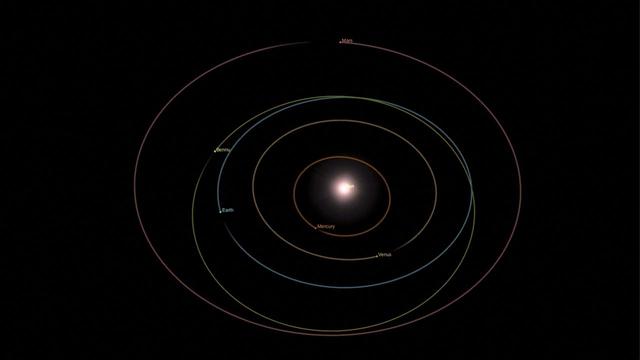
There are roughly 2,300 "Potentially Hazardous Asteroids" in the current catalog. These are objects large enough to cause regional or global catastrophe, with orbits that bring them close enough to Earth's path to matter. Astronomers have tracked most of them for decades. None are on a collision course.
That's the good news.
In February 2013, a meteor about 20 meters wide entered the atmosphere over Chelyabinsk, Russia. No warning. Nobody saw it coming. The shockwave shattered windows across six cities and injured 1,500 people — from a rock smaller than a house. It arrived from the direction of the sun, in a blind spot that ground-based telescopes simply can't cover.
That's why NASA funded the NEO Surveyor space telescope: to get above Earth's atmosphere and catch these objects years — ideally decades — before they become emergencies. You can watch tracked objects right now on the SkyLens live tracker.
The Clock Is the Variable That Changes Everything
Imagine an asteroid the size of a football stadium — roughly 200 meters wide — is confirmed tomorrow on an Earth-impact trajectory. What actually happens next depends almost entirely on one number: how many years of warning do we have?
A DART-style kinetic impactor works comfortably. A small nudge now equals a miss by thousands of kilometers when it arrives. This is the scenario we want.
More force needed. A nuclear standoff detonation — not drilling into the rock, but detonating a warhead nearby to vaporize surface material and push the asteroid off course — becomes the leading engineering option.
Partial deflection may shift impact probability, but evacuation of the predicted impact zone runs in parallel as the realistic backup.
We are evacuating. No technology currently exists to redirect a significant asteroid with months of notice. The clock is the entire game.
The Part Nobody Has Solved Yet
Here is where it gets genuinely unsettling.
If an asteroid was confirmed on a collision course tomorrow — who gives the order to deflect it?
NASA has a Planetary Defense Coordination Office, established in 2016. The United Nations has working groups. The International Asteroid Warning Network connects observatories on six continents. These are serious people doing serious work.
But there is no international treaty governing the authorization of a deflection mission. No agreed chain of command. No protocol for what happens if the launch country is different from the impact country. No legal framework for a scenario where the deflection slightly shifts the impact point rather than eliminating the threat entirely — which is a real engineering risk called "keyhole avoidance" — and the new predicted impact zone is a different nation than the original.
Planetary scientists have been raising this issue for two decades. As the situation now stands: a small group of countries have the technical capability to deflect an asteroid. None of them have a binding agreement on when or whether to act unilaterally if the timeline is short. The physics is solved. The governance is not.
Learn more about how orbital mechanics and threat cataloguing actually work on the SkyLens learn page.
What DART Left Behind
Dimorphos today is a different rock than it was before September 2022. The impact blasted a crater into the surface and sent a plume of debris hundreds of kilometers into space — a dust cloud that ground-based telescopes tracked expanding for weeks. The DART spacecraft itself: scattered atoms.
The follow-up mission from the European Space Agency arrives at the Didymos system in late 2026. Its job is to measure the crater, map the interior structure, and figure out precisely how and why the deflection worked better than modeled. The goal isn't just science — it's calibration. Turning a single successful demonstration into a technique repeatable enough to stake civilization on.
The Stakes, Simply Stated
The Chicxulub impactor — the one that ended the Cretaceous period 66 million years ago and took the dinosaurs with it — was roughly 10 to 15 kilometers across. The impact released energy equivalent to a billion nuclear weapons. Every non-avian dinosaur species on Earth was extinct within decades.
The dinosaurs had no warning system. No spacecraft. No planetary defense office.
We do. We've now proven the core technology works. What we're still assembling is everything around it: the telescopes to find threats decades out, the international protocols to authorize a response before precious lead time evaporates, and the political will to fund all of it during the long, quiet years when no asteroid is currently aimed at us.
For more stories about how humanity is navigating its relationship with space, read the SkyLens blog.
SkyLens editorial — live CelesTrak + NASA/JPL data (16122 objects)
Related stories