Mars · 2026-08-18
A Robot the Size of a Car Has Been Climbing a Mountain on Mars for 14 Years. It Was Built to Last 2.
It started with a stunt nobody had ever tried.
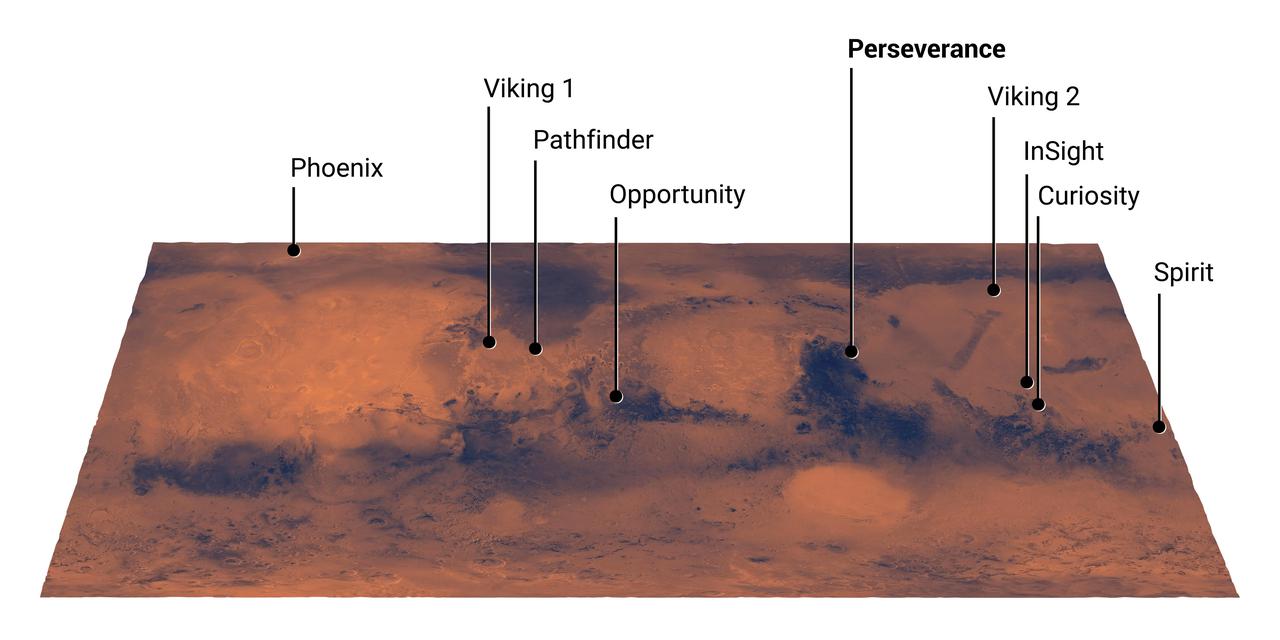
August 6, 2012. Gale Crater, Mars. A spacecraft entered the Martian atmosphere at 5.8 kilometres per second. It deployed a parachute. Then, with three kilometres still to go, a rocket-powered hovering platform — a sky crane — ignited its thrusters, lowered the rover on cables like a deep-sea fishing hook, and gently set it on the ground. Then the crane flew away and crashed deliberately, far enough not to damage what it had just delivered.
The world held its breath. NASA's engineers called it "seven minutes of terror." Every step had to work in perfect sequence — all automated, all unreachable. The signal delay between Earth and Mars is 8 to 24 minutes depending on the season. If anything went wrong, the rover would be rubble before anyone on Earth even knew.
It worked.
What landed that night was Curiosity. And it has been there ever since.
The 2-Year Mission That Refused to End
Curiosity was funded and designed for a primary mission of two Earth years. Two years of drilling, sampling, transmitting. Then the expectation was that something would break. A wheel. A computer. The cold — dropping to −80°C at night — would crack something critical. The Martian dust would clog something irreplaceable.
Instead, Curiosity is still climbing. Still drilling. Still phoning home across hundreds of millions of kilometres of empty space.
Its heart is a Radioisotope Thermoelectric Generator — essentially a nuclear battery, converting heat from decaying plutonium-238 into electricity. It doesn't need sunlight. It doesn't hibernate through dust storms the way solar-powered rovers do. The RTG will keep generating usable power until roughly 2030–2035. The real question isn't the power source. The question is which part of a 14-year-old robot gives out first.
The Mountain It Was Never Supposed to Climb
Gale Crater, where Curiosity landed, sits at the base of Mount Sharp — a 5.5-kilometre-tall mountain rising from the crater floor like a geological library. Each layer of rock is a chapter from Mars's ancient past. Older layers sit lower. Chemistry changes with altitude. Climb the mountain and you're reading a 3-billion-year history of a planet that was once warm, wet, and possibly alive.
Curiosity has been climbing for years. Maximum speed: about 150 metres per hour. You could outpace it on a bicycle. But it's not racing — it's reading. Every ridge, every drill hole, every scoop of ancient rock is a data point in the longest geological survey ever conducted on another world.
What It Found That Changed the Question
In 14 years, Curiosity didn't just suggest that Mars once had water. It proved it. Ancient lake beds. River deltas. Chemistry that shows liquid water persisted — not for decades, but potentially for millions of years at a stretch.
It found organic molecules — the carbon-based compounds that life uses — preserved in 3-billion-year-old rock. It detected methane fluctuating in the Martian atmosphere in seasonal patterns nobody expected. Something is producing and destroying methane on Mars today. Whether that something is geology or biology remains one of the most important open questions in science.
NASA is careful with the word "life." The official position: these findings are consistent with conditions that could have supported microbial life. The organic molecules could be geological. The methane cycles could be chemistry. Every result gets a measured, cautious interpretation — as it should.
But here's what is undeniable: Mars was once a world with liquid water, a thicker atmosphere, and chemistry that did not automatically exclude life. Curiosity confirmed that. Not as a hypothesis — as measured, drilled, analyzed fact. You can read more about what that means for the search for life over on the SkyLens science pages.
The Conversation That Takes 24 Minutes
Here is the part that makes your brain feel strange if you really sit with it.
Right now, at this moment, a robot built by human hands is sitting on the slope of a Martian mountain in a crater the size of Connecticut. It is cold. There is almost no atmosphere — about 1% of Earth's. The sky is a dusty, brownish pink. It has been there for 14 years without once receiving a reply in under 8 minutes. Without once being touched. Without once rebooting from human hands.
Its science team on Earth plans its days in Martian sols — 24 hours and 37 minutes each, slightly longer than an Earth day. Scientists rotate their sleep schedules to match Mars time. When Curiosity receives a command, it's already executing yesterday's thinking. When it sends data back, the team is seeing events that happened up to 24 minutes ago.
It is the slowest conversation in history. And it has been going for 14 years.
Sky crane landing in Gale Crater. Primary 2-year mission begins. Scientists are cautiously optimistic.
First confirmed evidence of an ancient habitable lake environment. Mars was definitively once wet — for a long time.
Organic molecules confirmed preserved in ancient rock. Carbon-based chemistry, 3 billion years old, intact.
Seasonal methane spikes detected — still unexplained. Geological chemistry, or something else?
Curiosity celebrates 14 years. Still climbing Mount Sharp. Still transmitting. Still surprising everyone.
What Happens When It Finally Dies?
Eventually, something will fail. A drill motor. An antenna actuator. The six wheels — each the size of a large dinner plate — already show significant wear from driving over sharp Martian rocks for a decade past their design life.
When Curiosity finally goes silent, it won't be retrieved. There are no humans on Mars to recover it. No tow truck is coming. It will simply stop, exactly where it is, on the slope of Mount Sharp, in Gale Crater, on Mars.
And it will stay there. Forever. A time capsule from 2012, resting on a planet that was once warm enough to hold oceans.
Future explorers — robots or humans — will find it exactly where it stopped. If humans ever walk in Gale Crater, they may drive past it. They'll know what it found. They'll know it did all of this alone.
Follow the SkyLens blog for more on what Mars missions are finding — and what the next generation of rovers is being built to hunt. Track every active satellite and deep-space mission in real time on the SkyLens live tracker.
SkyLens editorial — live CelesTrak + NASA/JPL data (16106 objects)
Related stories