Mars · 2026-08-09
Earth's Engineers Have Spent a Decade Arguing About Self-Driving Cars. Mars Settled the Debate in 2021 — and 90% of Every Kilometer Perseverance Has Driven Is the Proof.
Earth's engineers have spent a decade arguing about self-driving cars. Tesla Autopilot is still a regulatory battleground. Waymo is cautiously expanding city by city. Entire governments are debating who's liable when a robot makes a fatal decision.
Meanwhile, on the rust-red surface of another planet, a six-wheeled machine the size of a small car has been navigating completely alien terrain — alone, without roads, without GPS, without any map that existed before it got there — for over four years.
And new analysis published this week confirms that about 90 percent of every kilometer Perseverance has ever driven on Mars, no human was steering it.
Why It Has No Choice
Here's what most people don't think about when they imagine driving a rover on Mars.
You can't just grab a joystick and steer in real time. The signal from Earth takes between 3 and 22 minutes one-way to reach Mars — depending on where the two planets happen to be in their orbits around the Sun. Right now, it's on the longer end.
That means if Perseverance is heading toward a boulder and a controller on Earth spots it — by the time a "stop" command reaches Mars, the rover is already in the boulder. The round-trip delay for any single instruction is up to 44 minutes.
Real-time driving is physically impossible. Not technically difficult. Physically impossible. The speed of light is the limit, and Mars is too far away.
So NASA built AutoNav — an onboard autonomous navigation system that uses stereo cameras to map terrain ahead in real time, identify hazards, calculate safe paths, and drive — all without asking anyone's permission. The mission team tells it where to go. The rover decides how to get there.
What 90% Autonomous Actually Looks Like
When researchers say 90 percent of Perseverance's mileage is autonomous, this is what that means in practice.
The rover is navigating jagged volcanic rock fields. Loose regolith — powdery Martian soil — that could swallow a wheel and strand a billion-dollar machine. Ancient crater rims where a miscalculation means a drop nobody can recover from. It's making thousands of micro-decisions per drive: slow down here, steer left two degrees, this rock is stable enough to cross.
And it's doing all of this on a computer processor running at roughly 200 MHz.
Your phone runs at 3,000 MHz or higher. The self-driving rover navigating Mars has about 1/15th the processing power of the device in your pocket.
Where It's Been Going — and Why It Matters
Perseverance landed in Jezero Crater on February 18, 2021. Jezero isn't a random patch of Mars. It's an ancient river delta — a place where, roughly three billion years ago, liquid water flowed down from highland terrain, pooled into a lake, and sat long enough to potentially allow chemistry that leads to life.
The rover has been systematically sampling that lake bed ever since. Drilling into rocks. Caching core samples in sealed titanium tubes on the Martian surface. Building a library of material that a future mission is designed to retrieve and bring back to Earth.
If any of those samples contain biosignatures — the chemical fingerprint of ancient microbial life — it's the most important scientific discovery in human history.
Perseverance navigated to every single sample site largely on its own, across terrain no human has walked, with maps that didn't exist until its cameras created them in real time. You can follow the broader story of what it's hunting on the SkyLens explainers page.
The Helicopter That Changed Everything — and Then Stopped Flying
Perseverance didn't make this journey alone.
Attached to its belly at landing was Ingenuity — a small helicopter that was supposed to fly five times as a technology demonstration and then be left behind. A proof-of-concept. A footnote.
It flew more than 70 times.
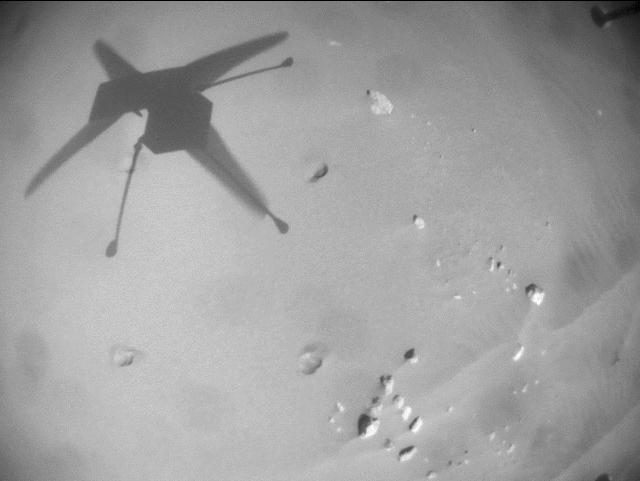
Ingenuity scouted terrain ahead of the rover, photographed routes from above, and proved that powered flight in Mars' atmosphere — just 1% the density of Earth's — is not only possible but practical. Engineers on Earth described watching it lift off for the first time as comparable to the Wright Brothers moment.
In January 2024, Ingenuity made a hard landing and damaged a rotor blade. Its flying days ended. But before it stopped, it had already changed the roadmap: NASA's next Mars mission is planning to fly multiple, larger helicopters. Ingenuity made them real.
Perseverance lands in Jezero Crater. Ingenuity tucked underneath, waiting.
Ingenuity completes its first flight — the first powered aircraft on another planet. It was supposed to stop there.
Ingenuity flies over 70 missions, scouts terrain, photographs areas no rover could reach. Becomes an essential science tool instead of a demo.
Hard landing. Rotor damage. Ingenuity's flight career ends — but its data reshapes every Mars mission after it.
Perseverance continues alone. AutoNav covers the ground. 90% autonomous, every kilometer.
The Implications Nobody Is Talking About
The success of AutoNav isn't just a feel-good engineering story. It rewrites the rulebook for every mission that comes next.
Consider where we're sending spacecraft in the coming decade. Europa Clipper — already en route to Jupiter — will eventually study an ice-covered moon with a liquid water ocean. Signal delay to Jupiter: 35 to 52 minutes one-way. Any lander mission to Europa would be operating at nearly total independence. Longer than any Perseverance drive. In an ocean nobody has ever seen.
Then there's Titan — Saturn's moon with methane lakes and orange nitrogen skies. Signal delay: 67 to 87 minutes. NASA's Dragonfly nuclear helicopter, launching in 2028, will fly autonomously through Titan's thick atmosphere with no possibility of real-time guidance.
Everything being learned from Perseverance's 90% autonomous mileage feeds directly into those missions. The self-driving rover on Mars isn't a destination. It's a proof-of-concept for exploring a solar system where the speed of light makes remote control impossible.
Earth Still Can't Agree. Mars Already Did.
Autonomous vehicles on Earth navigate roads built for humans — covered in lane markings, traffic signals, reflective signage, and GPS signals. They're surrounded by infrastructure specifically designed to keep them from making fatal decisions.
Perseverance navigates a world nobody has mapped, using terrain data that doesn't exist until its own cameras create it, on a planetary surface no human engineer has ever physically visited.
And it's been getting it right — almost every single kilometer, for over four years — entirely on its own.
The argument about self-driving technology playing out across Earth's newsrooms and regulatory bodies? The engineers who built AutoNav had to solve a harder version of that problem in 2020, with no margin for error and no one to call if it went wrong.
They solved it. Mars has a self-driving car. It's been working since 2021. We just weren't paying attention.
For more on the space missions currently active — and the objects moving through our solar system right now — explore the SkyLens live tracker or browse the full archive of stories at the SkyLens blog.
SkyLens editorial — live CelesTrak + NASA/JPL data (16106 objects)
Related stories