Astrobiology · 2026-07-11
A Moon Smaller Than England Has Been Leaking Its Underground Ocean Into Space for Millions of Years. Last Year, Scientists Found the Last Ingredient for Life Inside It.
Deep beneath a shell of ice, on a moon smaller than England, there is a liquid ocean that has never once seen the Sun.
That ocean is actively shooting itself into space right now — in jets of water vapor and ice crystals that rise hundreds of kilometers before drifting into Saturn's rings. It has been doing this for millions of years.
And in 2023, scientists found the last thing they were looking for inside those jets.
Every single building block for life. Confirmed. All six.
Meet Enceladus. The moon most people have never heard of. The place that may answer the biggest question in science.
A World That Shouldn't Exist
Enceladus orbits Saturn at roughly 238,000 km from the planet — about the same distance the Moon is from Earth. At just 500 km across, you could drive the length of it in about five hours. It receives less than 1% of the sunlight Earth does. It should be a frozen, geologically dead rock.
It is not.
Saturn's gravity constantly flexes and squeezes Enceladus as it orbits — generating enough internal heat to keep a global liquid ocean from freezing. The structure: a rocky seafloor at the bottom. A deep saltwater ocean above it. A crust of ice, 30 to 40 km thick, sealing everything in.
And the crust has cracks.
The Fountains at the End of the Solar System
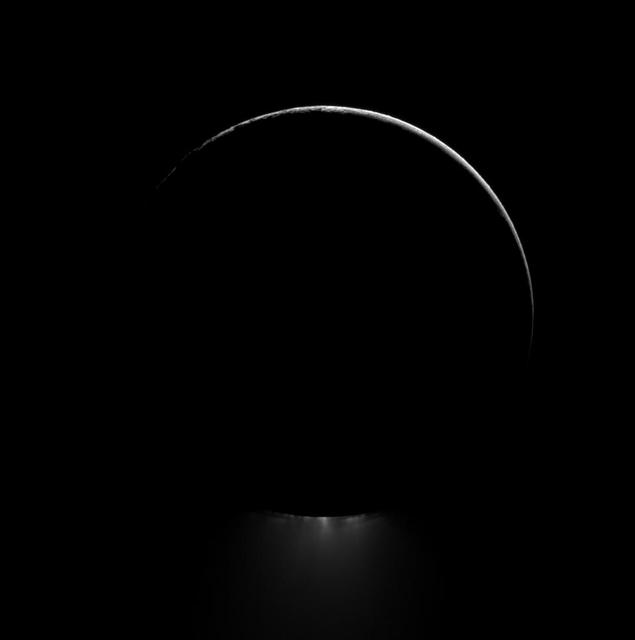
At Enceladus's south pole, there are four parallel fractures in the ice crust — nicknamed the "tiger stripes." Each one is about 130 km long and 2 km wide. And through them, the ocean below vents continuously into space.
Water vapor. Ice crystals. Organic molecules. All of it firing upward at around 400 meters per second — fast enough to escape the moon's gravity and drift outward into Saturn's orbit. The entire E-ring of Saturn — that diffuse, wispy band visible in amateur telescopes — is made almost entirely of water from inside Enceladus. The moon has been feeding that ring for a very long time.
When NASA's Cassini spacecraft first confirmed this in 2005, scientists checked their instruments twice. A moon this small, this far from the Sun, spraying liquid water into space? By every model they had, it wasn't supposed to be possible.
What We Found When We Flew Through It
Cassini didn't just observe the plume from a distance. It flew through it.
Multiple times.
Between 2008 and 2015, the spacecraft made a series of targeted plume dives — dipping as low as 49 km above the surface, flying directly through the geyser material with instruments running. The readings came back over the years that followed.
Water. Salt — the same sodium chloride as Earth's oceans, which suggested the water had been dissolving rock for a very long time. Organic molecules. Carbon dioxide. Methane. And then, in 2017, something that stopped the scientific community in its tracks: molecular hydrogen.
Molecular hydrogen is a byproduct of hot water reacting with rock — a process called serpentinization. On Earth, that process happens at deep-sea hydrothermal vents. And at those vents, without any sunlight, without any photosynthesis, life thrives. Tube worms. Shrimp. Chemosynthetic bacteria. Entire ecosystems that have never needed the Sun, powered entirely by chemical reactions between water and rock.
The hydrogen told scientists something specific: there are active hydrothermal vents at the bottom of Enceladus's ocean. Right now. Pumping heat and chemistry into the water above them.
The 2023 Discovery That Changed the Conversation
Scientists have a shorthand checklist for life: CHNOPS. Carbon. Hydrogen. Nitrogen. Oxygen. Phosphorus. Sulfur. Every known living thing on Earth requires all six.
By 2022, Cassini data had confirmed traces of five of the six in Enceladus's plume. Carbon, hydrogen, nitrogen, oxygen, sulfur — all present. Only phosphorus was missing. And phosphorus matters enormously. It is the backbone of DNA and RNA. Without it, life as we know it cannot store or transmit genetic information. Some researchers had started to worry that Enceladus's ocean might be phosphorus-poor — a dealbreaker for complex chemistry.
Then in June 2023, a team re-analyzed Cassini's mass spectrometer data from Saturn's E-ring — the ring composed almost entirely of Enceladus plume material. They found sodium phosphates.
Phosphorus. In the water. Being shot out of the ocean. Into space.
The paper, published in Nature, noted that concentrations appeared at least as high as Earth's oceans — possibly higher. Enceladus's ocean is not just wet. It appears chemically rich.
To be precise: the detection of phosphorus came from re-analysis of archived Cassini data, not a new mission. The finding has been peer-reviewed and published in one of science's most rigorous journals. However, confirming life itself requires far more than chemistry — this tells us the ingredients are there, not that anything is using them. Scientists are careful to say habitable conditions, not inhabited.
What Life There Might Look Like
It would not be anything like us.
The ocean is in complete darkness. Photosynthesis is impossible. Any life would almost certainly be microbial — bacteria-like organisms clustered around hydrothermal vents on the ocean floor, deriving energy from chemical reactions rather than light. Single-celled. Invisible to the naked eye. Living in conditions humans would call extreme.
But here's the thing about "extreme" by life's standards: on Earth, organisms survive at 120°C in volcanic vents, under crushing pressures, with no oxygen and no light. Life has colonized every hostile environment we've ever pointed a camera at on this planet.
And if microbial life exists in Enceladus's ocean, it would eventually be swept up by convection currents and carried toward the tiger stripes — and fired into space. We wouldn't need to drill through the ice. The ocean is mailing itself to us. We flew a spacecraft through it in 2015 and may not have had the instruments sensitive enough to recognize what we were passing through.
That thought sits differently once you sit with it.
The Problem: No One Is Going Back
Cassini ended in September 2017 — deliberately plunged into Saturn to prevent any chance of contaminating Enceladus or Titan with Earth microbes. No spacecraft is currently en route to the moon.
There are proposals. NASA's Enceladus Orbilander concept — a spacecraft that would orbit the moon, fly through the plume repeatedly with modern instruments, and potentially land on the surface — has been recommended as a high priority by the planetary science decadal survey. But it has not been funded. A mission of that kind would not arrive until the 2050s at the earliest.
Europa Clipper, which launched in October 2024 and will reach Jupiter in 2030, will study a similar ocean world and teach us how subsurface seas behave — valuable context for any future Enceladus mission. But Europa Clipper will not go near Saturn.
For now, the most compelling place in the solar system to search for life outside Earth sits 1.2 billion kilometers away, actively spraying samples into space, waiting for someone to come and look properly.
Why This Might Matter More Than Mars
Mars gets most of the attention — it's close, it was once wet, and we've sent rovers and landers for decades. But Mars today is cold, dry, and nearly unprotected from solar radiation. Whatever life may have existed there is almost certainly ancient history.
Enceladus has liquid water right now. Hydrothermal activity right now. A complete chemical inventory for life right now. Its ocean is shielded from radiation by tens of kilometers of ice. The environment has likely been stable for hundreds of millions of years.
If you had to place a bet — using the evidence that actually exists — the most promising address in this solar system is a moon you've probably never heard of, orbiting a planet famous for its rings, 1.2 billion kilometers from where you're reading this.
It's been sending us samples for a long time. We just haven't gone to collect them yet.
You can track every spacecraft currently in Earth orbit on our live tracker, but the mission that changes everything might be the one that hasn't launched. Want more stories like this? The SkyLens archive goes deep on the solar system's most surprising science.
SkyLens editorial — live CelesTrak + NASA/JPL data (15993 objects)
Related stories