Astrobiology · 2026-06-11
There's More Water on This Moon of Jupiter Than on All of Earth Combined. A Spacecraft Is Already Flying There to Find Out If Something Is Alive Inside It.
Beneath 25 kilometers of solid ice, there is an ocean that has never seen sunlight. It has been there for four billion years. Warmed not by any star, but by the gravitational squeeze of Jupiter — a planet so massive it literally kneads its moons like dough.
That ocean is on Europa. One of Jupiter's 95 moons. Slightly smaller than our own Moon. And right now, a spacecraft is on its way there.
An Ocean Nobody Expected
In the 1990s, NASA's Galileo spacecraft flew past Europa and detected something anomalous. The magnetic field kept shifting in ways that made no sense — unless there was a layer of electrically conductive saltwater beneath the ice. Scientists sat with that data for years. Then they accepted it.
A liquid ocean. Completely sealed under a frozen crust. Deeper than anything on Earth.
Think about that for a second. We call Earth the "water planet." It's the reason we're blue from space. And Europa — a frozen moon orbiting a gas giant 628 million kilometers away — has more water than we do.
The Cracks That Gave It Away
Look at Europa's surface and you see a cracked eggshell. Thousands of red-brown lines crisscross the entire globe, some stretching farther than the width of a continent. Scientists think those are tidal fractures — places where Jupiter's gravity tears the ice open, ocean water seeps up, freezes, and leaves a stain.
Those reddish stains are probably sea salt. From the ocean below. Pushed up through cracks by tidal forces, left behind when the water refreezes. Europa's entire surface is effectively a record of what's happening beneath it.
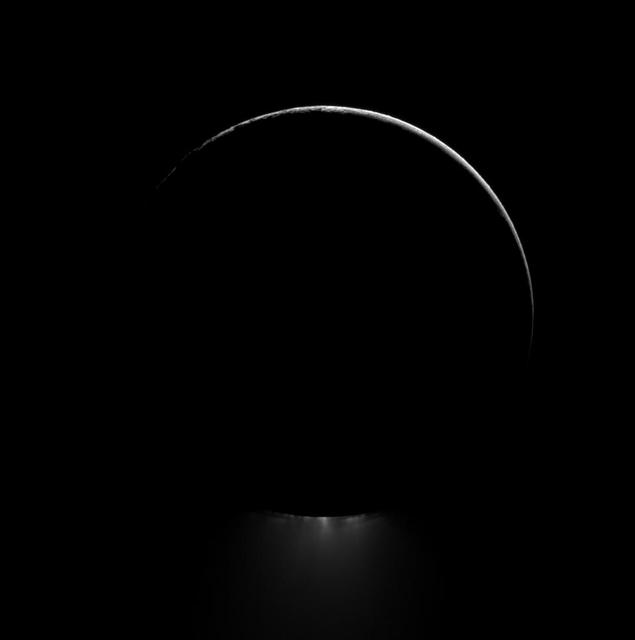
Then, in 2012 and 2013, the Hubble Space Telescope spotted something that changed the conversation entirely: water vapor plumes erupting 200 kilometers above Europa's southern pole.
The ocean wasn't just sitting there. It was venting. Like a geyser punching through the ice and spraying into space.
That plume discovery changed the mission architecture. Suddenly, we didn't have to drill through 25 kilometers of ice to sample the ocean. A spacecraft could fly directly through the spray. Catch the water mid-eruption. Analyze it for chemistry, for organics, for the molecular fingerprints of biology.
Why Life Could Exist Down There
For most of human history, we assumed life required sunlight. Then in 1977, a deep-sea submersible exploring the Pacific floor found something that rewrote the textbooks: hydrothermal vents at 2,500 meters depth, in complete darkness, supporting entire ecosystems of creatures that had never seen the Sun.
Tube worms. Crabs. Fish. Shrimp. All thriving on chemical energy from Earth's interior. No photosynthesis. No sunlight. Just heat, minerals, and water.
Europa's ocean floor may have identical conditions. Tidal heating from Jupiter — the same force that keeps the ocean liquid — likely drives hydrothermal activity at the seafloor. If those vents exist, three ingredients converge: liquid water, chemical energy, and complex minerals dissolving from the rocky seafloor into the ocean above.
That is the recipe. That is exactly the environment where life emerged on Earth.
If you want to understand how scientists evaluate habitability and what biosignatures actually look like, the SkyLens learn section breaks down the science behind the search.
The Spacecraft That's Already Flying
On October 14, 2024, NASA launched Europa Clipper. The largest planetary science spacecraft NASA has ever built — roughly the size of a basketball court when its solar panels are deployed. It is currently somewhere between Earth and Jupiter, traveling tens of thousands of kilometers per hour on a trajectory that swings past Mars, back past Earth for a gravity assist, and then out toward Jupiter.
It arrives in 2030.
Once there, it will not land. The radiation environment around Jupiter is intense enough to destroy electronics in days. Instead, Europa Clipper will make 49 close flybys — swooping as low as 25 kilometers above Europa's surface — sampling the thin atmosphere, mapping the ice in detail, measuring the magnetic field, and, if the orbital timing lines up, flying directly through an active water plume.
The instruments on board can detect amino acids, fatty acids, and other organic molecules — the chemical signatures of biology. They cannot confirm life. But they can tell us whether the chemistry is trending in the right direction, and whether the ocean is the kind of place that could sustain it.
What Happens the Day We Find Something
Scientists don't love answering this question publicly. Because the implications run in all directions at once.
If microscopic life is confirmed in Europa's ocean — life that evolved completely independently from Earth — it means biology is probably universal. Billions of ocean worlds across the galaxy. Billions of chances for chemistry to flip into life. The question "are we alone?" gets answered in a single press release. And then a much harder set of questions begins.
International planetary protection rules already govern this scenario. Any spacecraft that could contaminate Europa must be sterilized to extreme standards before launch. Any probe that might carry Earth microbes into an extraterrestrial ocean — and potentially destroy the very ecosystem we're trying to find — is strictly prohibited. These protocols exist because scientists have been thinking seriously about this for decades.
However: there's also a scenario that's less dramatic but equally important. We find nothing. A dead ocean, chemically rich, physically habitable, but biologically empty. That result matters too. It would tell us that Earth's emergence of life was genuinely rare — that conditions alone aren't sufficient. Both outcomes are scientifically valuable. Either way, we come out knowing something fundamental about where we stand in the universe.
Europa Is Not Alone
Europa is the most discussed ocean world, but it's not the only one. Saturn's moon Enceladus is actively erupting ocean water into space right now — and NASA's Cassini spacecraft already flew through those plumes and found organic molecules, molecular hydrogen (a chemical sign of hydrothermal activity), and silica nanoparticles from the seafloor. Titan has lakes of liquid methane. Ganymede, Callisto, Triton, and possibly Pluto all likely harbor liquid water beneath frozen crusts.
The solar system is wet. Remarkably, unexpectedly, strangely wet. And we are only now building the instruments capable of actually looking inside.
You can follow along as Europa Clipper travels toward Jupiter — the SkyLens live tracker covers active missions and solar system objects in real time. The spacecraft won't arrive until 2030, but the physics that makes this mission possible is the same physics governing every satellite and object you can visualize on the globe right now.
In the meantime, there's no shortage of strange things happening in the space between Earth and Jupiter. More stories worth your time — the universe keeps producing them faster than we can explain them.
SkyLens editorial — live CelesTrak + NASA/JPL data (15679 objects)
Related stories