Deep Space · 2026-11-21
Andromeda Galaxy Collision: One Trillion Stars Are Headed Directly for the Milky Way — and You Can Already See Them Coming
Right now, a galaxy containing one trillion stars is falling directly toward us.
It's been falling for billions of years. We only worked out the full trajectory recently — once our telescopes became precise enough to measure the drift of a smudge of light more than two million light-years away.
The Andromeda galaxy collision with the Milky Way is not a theoretical warning. It's confirmed physics, measured by Hubble, refined by the ESA's Gaia spacecraft, modelled in exhaustive simulations. And it ends with the galaxy we live in ceasing to exist as a recognisable structure. The same laws of gravity that keep the 15,000 satellites SkyLens tracks in orbit — just scaled up until the solar system looks like a dust speck.
Will Andromeda really collide with the Milky Way?
Yes. This is not a hypothesis — it's observed motion. The same method we use to calculate asteroid trajectories: measure the position, measure it again years later, calculate the path.
In 2012, a team using Hubble Space Telescope data published the most precise measurement yet of Andromeda's motion — not just its speed toward us, but its sideways drift across the sky. That lateral measurement determines whether a collision is head-on, glancing, or a near-miss. After tracking Andromeda's position for over six years, the conclusion was unambiguous: it's coming in too close to avoid. The ESA's Gaia spacecraft has since added further precision. The error bars have shrunk.
To be fair: the exact geometry of the collision still carries real uncertainty. The range goes from a glancing merger to a near head-on impact. But a miss isn't in the models. No measurement of Andromeda's velocity has ever suggested it will veer clear.
How far away is Andromeda right now?
2.537 million light-years. The light reaching your eyes from Andromeda tonight left before Homo erectus existed. Before the first stone tools. Before almost anything recognisable as human walked the Earth.
And yet Andromeda is so massive — roughly three times as many stars as the Milky Way — that you can see it with the naked eye. Step outside on a clear autumn night. Find the constellation Andromeda above the northeastern horizon. Look for the faintest possible smudge. That's it. The most distant object the unaided human eye can detect. Already on its way.
When will the Andromeda collision happen?
The best current estimates put the first close pass between 3.75 and 4.5 billion years from now — the spread reflects ongoing refinement of Andromeda's exact trajectory. At that point, the two galactic discs begin overlapping. After the first pass, gravity won't let them go. They'll swing apart slightly, loop back, fall together again. The full merger — both nuclei settled into a single combined structure — is projected at roughly 6.6 billion years total.
Put that in perspective: the Sun is currently 4.6 billion years old. By the time the Milky Way and Andromeda finish merging, the Sun will have burned through most of its remaining hydrogen and swelled into a red giant. These two events — the death of our star and the end of our galaxy — are unfolding on nearly the same schedule.
What actually happens when two galaxies collide?
Not what you're picturing.
No fire. No explosions. No stars crashing into each other. This isn't a demolition derby — it's more like two vast, nearly-empty clouds interpenetrating, pulled by invisible threads of gravity.
Here's why: the distance between individual stars is enormous even inside a dense galaxy. If the Sun were the size of a marble, the nearest star — Proxima Centauri — would be more than 500 kilometres away. Scale that up to hundreds of billions of stars and you have an object that is almost entirely vacuum. When Andromeda passes through the Milky Way, the probability of any two specific stars colliding is roughly one in a million. The galaxies will pass through each other like two overlapping clouds of gnats — most of them never touching.
What does happen is gravitational chaos on a magnificent scale. Stars scatter onto completely new orbits. Cold gas clouds smash together and compress, triggering intense bursts of new star formation — the merger will briefly make the result one of the most actively star-forming objects in the local universe. And at the centre of each galaxy sits a supermassive black hole: the Milky Way's Sagittarius A* (4 million solar masses) and Andromeda's central black hole (which may be 10–100 times more massive). Over millions of years, they will spiral inward and merge in an event that releases more energy in gravitational waves than anything else in the history of the Local Group.
Will Earth survive the Andromeda collision?
Almost certainly, yes — but not in any position you'd recognise.
The Sun will almost certainly survive the merger. The odds of it being hit by another star are vanishingly small. However, it will very likely be gravitationally kicked from its current position in the Milky Way's disc. Computer simulations suggest a roughly 50% chance the Sun ends up in the extended halo of the merged galaxy — far from the dense, star-forming core, orbiting at perhaps twice its current distance from the galactic centre. The cosmic neighbourhood of the future will look nothing like the one today.
As for Earth specifically — by then, the Sun will already be nearing red giant phase. Earth's fate is uncertain regardless of Andromeda. The merger may actually be the least of our problems on a 4-billion-year timescale.
What will the night sky look like during the merger?
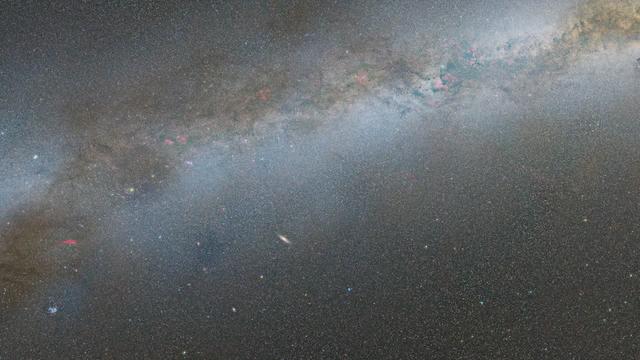
Right now, Andromeda already spans about six times the width of the full Moon in our sky. It's just too faint to see clearly except under very dark skies — but the structure is there. It's enormous.
As the merger begins, it will grow. First imperceptibly, then overwhelmingly. In the final billion years before first contact, Andromeda's disc will visibly dominate the heavens — sweeping across a vast arc of sky, its core outshining every planet. As the galactic discs interpenetrate, new star-forming regions will ignite across the combined structure: glowing clouds of ionised gas and young blue stars blazing into existence across a sky reshaped by tidal forces beyond imagining.
No human will ever see this. But the physics is already running. The clock started before the first dinosaur.
What is Milkomeda — and what will it look like?
Astronomers have already named the result: Milkomeda. (Some call it Milkdromeda — the naming conventions aren't settled, which feels appropriate for a galaxy that doesn't yet exist.)
It won't look like either of its parents. Both the Milky Way and Andromeda are elegant spiral galaxies — disc-shaped, with sweeping arms, still actively forming stars. Milkomeda will be neither. The gravitational disruption of the merger will scramble those spirals into a giant elliptical galaxy: a vast, featureless ball of old stars, slowly cooling and dimming as new star formation decreases over billions of years.
This isn't an unusual fate. It's the standard outcome of major galaxy mergers. The enormous elliptical galaxies that dominate the centres of clusters like Virgo or Coma — many of them are what spirals look like after they've collided. We happen to be watching from inside one of the spirals, a few billion years before the story ends. The SkyLens blog has covered some of these already-merged remnants — including the Sombrero Galaxy, which carries the remnants of everything it's already consumed.
Andromeda is visible to the naked eye — a faint smudge spanning six full Moons in width, invisible to most people, closing at 110 km/s
First close pass. Galactic discs interpenetrate. Stars scatter onto new orbits. A burst of star formation ignites across both galaxies. The night sky transforms beyond recognition.
The galaxies swing apart, loop, and fall back together for a second pass. The Sun has likely been displaced from its current galactic position.
Milkomeda is born. Two supermassive black holes spiral together at the centre. The Milky Way band that defined every human night sky in history is gone forever.
There's something almost meditative in this. Everything we consider permanent — the constellations, the galactic band overhead, the specific patch of universe Earth orbits through — is temporary. The Milky Way itself was assembled from smaller galaxies over billions of years. It is absorbing dwarf galaxies right now. And in 4 billion years, it will begin its own absorption into something larger and stranger.
The universe doesn't build monuments. It builds processes.
Step outside tonight on a clear night. Find that faint smear of ancient starlight in the constellation Andromeda — the almost-nothing above the northeastern horizon. That's a trillion suns, 2.537 million light-years away, already in motion. It has been falling toward us for the entire history of life on Earth. It has 4 billion years still to go. And when it arrives, the night sky that every human in history looked up at will be replaced by something that has never existed before.
SkyLens editorial — live CelesTrak + NASA/JPL data (15927 objects)
Related stories