Space Science · 2026-10-16
Dark Matter Explained: The Invisible Force That Built Every Galaxy — and Why 90 Years of Searching Have Found Absolutely Nothing
The Milky Way shouldn't exist.
By the laws of physics, stars at the edge of our galaxy should spin off into the void — the way water flings off a spinning wheel. The gravity from visible stars and gas simply isn't strong enough to hold them in. And yet, here we are. Here everything is.
Something invisible is holding the universe together. Scientists call it dark matter. It makes up 27% of everything that exists. We've been hunting for it since 1933. We've never found a single particle.
That last number. Five percent. Every star, planet, ocean, mountain, person, and atom you've ever encountered — that's five percent of what exists. The universe you know is the footnote.
What is dark matter, exactly?
Dark matter is whatever is providing the extra gravity holding galaxies together — gravity that cannot be explained by ordinary matter alone. It doesn't emit light. It doesn't absorb light. It doesn't interact with electromagnetic radiation at all. The only thing we know dark matter does is pull.
It's not dark like darkness. It's dark like invisible. Radio telescopes can't see it. X-ray satellites can't detect it. You could walk through a cloud of dark matter and feel nothing — yet without it, every galaxy in the universe, including our own, would have disintegrated billions of years ago.
Who discovered dark matter?
The first person to notice something was off was a Swiss astronomer named Fritz Zwicky. In 1933, he was studying the Coma Cluster — a group of over a thousand galaxies moving together in space. When he measured their speeds, he found they were moving far too fast. The visible mass of those galaxies couldn't generate enough gravity to keep them from flying apart. He proposed there must be unseen matter — dunkle Materie in German — holding everything together.
His peers ignored him for decades.
Forty years later, a young astronomer named Vera Rubin came to the same conclusion from a different direction. She spent years measuring how fast stars orbit the centres of galaxies. She found something deeply wrong: stars at the outer edges of galaxies were moving just as fast as stars near the centre. That shouldn't happen. It's like finding cars at the edge of a roundabout travelling just as fast as cars right next to the hub. Physics says the outer stars should be slower. They weren't.
Rubin's explanation: every galaxy is surrounded by a vast, invisible halo of dark matter extending far beyond the visible disk — providing the extra gravity keeping the outer stars from flying off. She spent years being told her data was wrong. It wasn't. She had discovered that the universe is mostly invisible.
What is the best evidence for dark matter?
In 2006, astronomers photographed something extraordinary: two massive galaxy clusters in the act of colliding. The system is called the Bullet Cluster, located 3.7 billion light-years away.
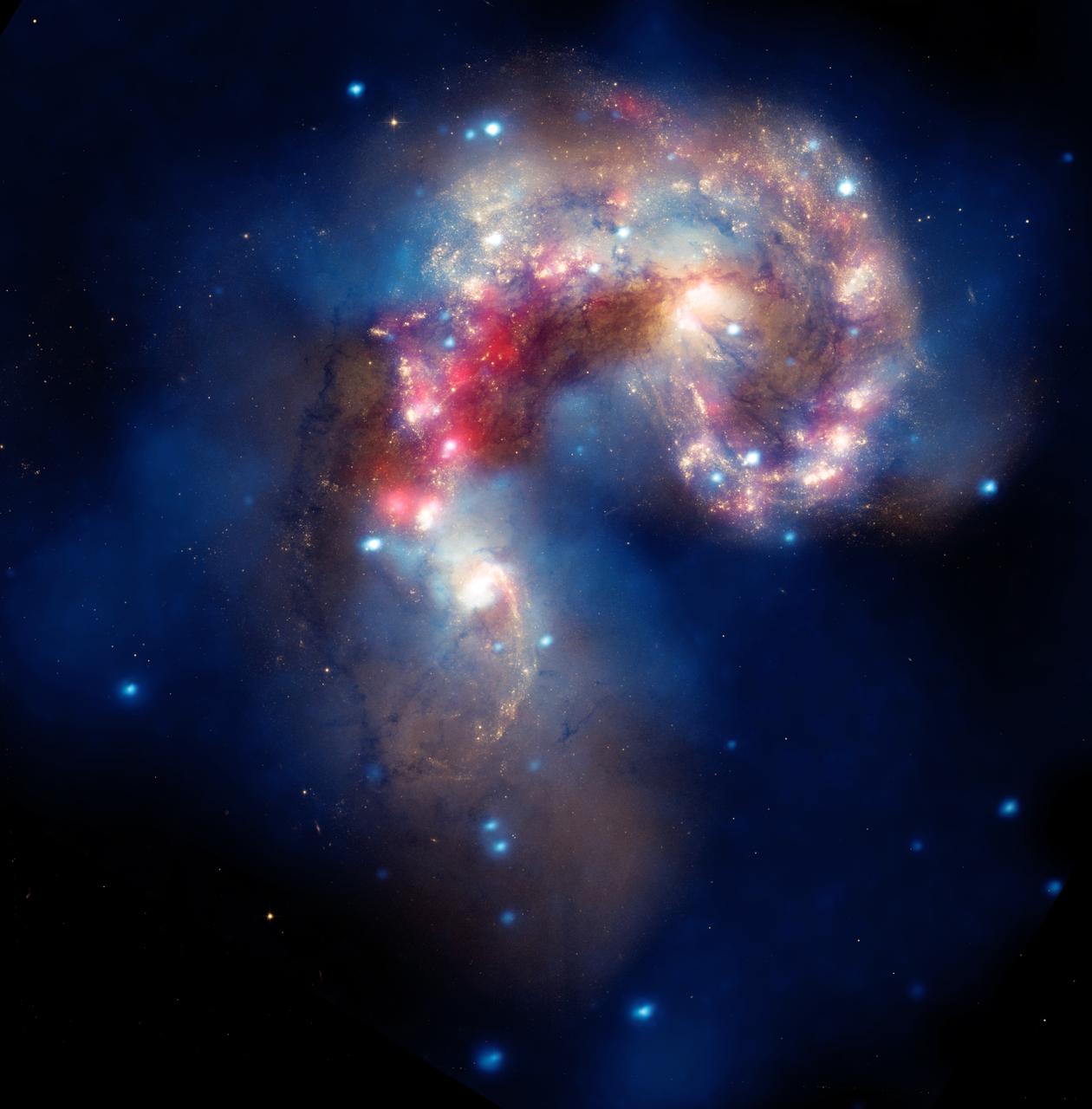
When the clusters smashed through each other, the hot gas — ordinary, visible matter — slowed down and lit up in X-rays, glowing like a fireball. You could see it with the Chandra X-ray Observatory. But when astronomers used gravitational lensing — measuring how the clusters bent light from background galaxies — to map where all the mass was, the mass wasn't where the gas was. It had sailed through the collision, undisturbed, and kept going.
The dark matter had passed through like a ghost. The gas got stuck. They went in different directions. We can map exactly where the dark matter went. We just can't see it.
From 15,968 catalogued satellites tracked in real time on the SkyLens live tracker to the invisible scaffolding of galaxy clusters — the universe hides its most important structures in plain sight.
What could dark matter actually be?
After 90 years and hundreds of experiments, we don't know. There are candidates:
- WIMPs (Weakly Interacting Massive Particles) — the long-time favourite. Heavy particles that barely interact with ordinary matter, theoretically produced in the Big Bang. Searched for obsessively. Never found.
- Axions — ultra-light hypothetical particles. Experiments like ADMX and HAYSTAC are scanning for them now. Nothing confirmed yet.
- Sterile neutrinos — a heavier cousin of the neutrino that doesn't interact even via the weak force. Theoretically possible. Experimentally elusive.
- Primordial black holes — microscopic black holes formed in the Big Bang. Some gravitational-wave detections have been cautiously proposed as evidence. Not confirmed.
Why haven't we found dark matter yet?
The most sensitive dark matter detector on Earth is buried inside a former gold mine in Lead, South Dakota. It's called LUX-ZEPLIN (LZ). It contains ten tonnes of liquid xenon, cooled to –100°C, shielded from cosmic rays by 1.5 kilometres of solid rock. Its entire purpose is to catch the moment a dark matter particle bumps into a xenon atom and produces a flash of light.
It's been running since 2022. It has found nothing.
Neither has XENON1T inside Italy's Gran Sasso mountain. Nor its successor XENONnT. Nor PandaX in China. The Large Hadron Collider at CERN has been smashing protons together for two decades — theoretically recreating Big Bang conditions where dark matter particles should appear. Nothing.
The absence of a signal hasn't disproved dark matter. It's narrowed the range of what it could be. WIMPs that interact more weakly than predicted may still exist. Axions could be orders of magnitude lighter than early models suggested. Or the answer could be something physicists haven't yet imagined.
Could dark matter not be real at all?
Some physicists propose an alternative: maybe our gravity equation is wrong. A theory called MOND (Modified Newtonian Dynamics) suggests gravity works slightly differently at very low accelerations — which could explain galaxy rotation curves without dark matter.
The problem: MOND works reasonably well for individual galaxies. It catastrophically fails for galaxy clusters like the Bullet Cluster, where the mass and the visible matter clearly separate during a collision. It also can't reproduce the precise structure of the cosmic microwave background — the afterglow of the Big Bang — that dark matter models predict accurately. Most cosmologists still lean heavily toward dark matter being real.
Why does dark matter matter to us?
Without dark matter, the first galaxies wouldn't have formed at all. Regular matter alone is too spread out, too hot, too turbulent after the Big Bang to collapse into structures on its own. Dark matter — moving faster, unslowed by electromagnetic interactions — collapsed first. It built the scaffolding. Regular matter fell into the gravitational wells dark matter carved out.
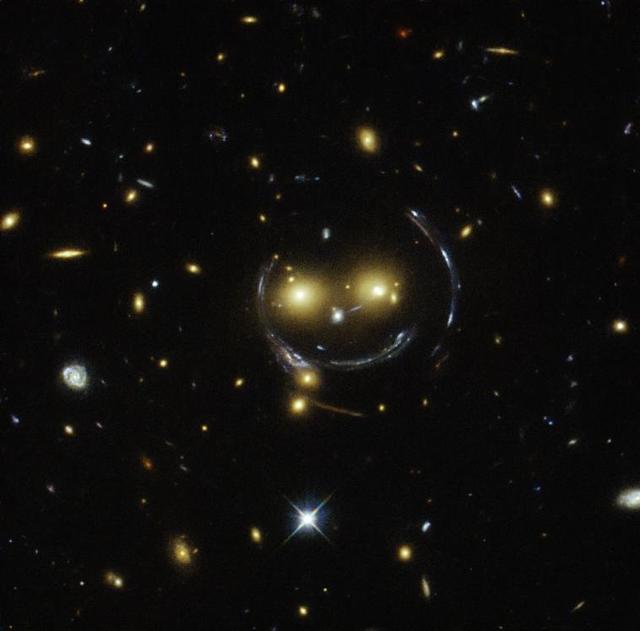
The filaments and voids of the cosmic web — the vast large-scale structure of the universe — are essentially the skeleton of dark matter made visible by the gas and galaxies that pooled inside it. Every galaxy sits inside a dark matter halo. Every galaxy cluster is embedded in a dark matter superstructure.
Without dark matter: no galaxies. No stars. No Earth. No us.
It's one of the most uncomfortable positions in modern science: a substance that apparently constitutes more than a quarter of the universe, that we cannot live without, that evidence clearly shows exists — and that we cannot find no matter how hard we look. Learn more about the forces shaping our cosmos on the SkyLens learn page.
What happens next in the dark matter search?
The hunt isn't slowing down. LZ will take years more of data, probing ever-weaker interaction strengths. The next generation of axion detectors is coming online. The Nancy Grace Roman Space Telescope, scheduled to launch in 2027, will map gravitational lensing across the sky at a scale never attempted — directly tracing dark matter filaments across billions of light-years of space.
And a quieter possibility exists — one physicists discuss more openly now than they used to: that dark matter is genuinely beyond current physics. That the answer requires a theoretical framework we haven't yet invented. That we are, in 2026, exactly where Fritz Zwicky was in 1933: staring at something real, something massive, something absolutely fundamental — and completely unable to see it.
For 90 years, every time we've looked harder, we've confirmed dark matter's gravitational grip on the universe and learned nothing new about what it actually is.
The universe appears to be mostly made of something we've never directly detected. That should keep you up at night.
SkyLens editorial — live CelesTrak + NASA/JPL data (15968 objects)
Related stories