Space Discoveries · 2026-09-17
Carina Nebula: NASA Photographed a 'Treasure Chest' of Stars Today — and the Monster Inside It Is Preparing to Outshine the Moon
A single star inside the Carina Nebula has already exploded once — and somehow kept burning. It weighs roughly 100 times the mass of our Sun. In 1843 it briefly outshone almost every star in the sky. Sailors navigated by it. Scientists had no idea what they were watching. Then it dimmed. And it's been slowly brightening ever since.
Today, NASA published a new Astronomy Picture of the Day featuring the Carina Nebula — a glowing cloud 7,500 light-years away packed so densely with newborn stars that astronomers called it a treasure chest. That's one way to describe it. Another way: it's the most violent star nursery in our galaxy, and the most dangerous object inside it is very much still alive.
What is the Carina Nebula?
It's one of the largest star-forming regions in the Milky Way. From the Southern Hemisphere it's visible to the naked eye — a faint smudge in the constellation Carina, roughly 300 light-years end to end. Light travelling at 300,000 km per second needs three centuries just to cross it.
Inside this glowing cloud, stars are being born constantly. Gas collapses under its own gravity, heats up, ignites nuclear fusion, and a new sun switches on. The Carina Nebula has been doing this for millions of years. The stars it produces range from tiny red dwarfs to colossal blue giants that will live fast and die violently. In today's NASA image, almost every bright speck is either a star younger than the dinosaurs — or one already old enough to die.
What makes Eta Carinae so unusual?
Most of the thousands of stars inside the Carina Nebula are quietly doing what stars do. Then there's Eta Carinae. It breaks nearly every rule.
Eta Carinae is estimated at roughly 100 times the mass of our Sun — and it burns with the fury to match. It's one of the most luminous stars ever catalogued. Stars this massive push the theoretical upper limit of how large a sun can get before radiation pressure tears it apart from the inside. Yet here it is, still burning.
Eta Carinae is actually a binary system — two massive stars orbiting each other every 5.5 years. Each time the companion swings close, it adds gravitational stress to a star already operating at its structural limit. Astronomers watch this orbital cycle the way a structural engineer watches a cracked bridge.
Did Eta Carinae really already explode?
Sort of. In 1843, Eta Carinae underwent what astronomers now call the Great Eruption. It brightened so dramatically that it became one of the brightest stars in Earth's sky — surpassed only by Sirius. Sailors in the Southern Hemisphere used it for celestial navigation. Scientists and amateur observers recorded its brilliance with the instruments of the era. Nobody understood what they were seeing.
It wasn't a supernova. It was something stranger: a supernova impostor. The star ejected an estimated 10 to 40 times the mass of our entire Sun in a matter of years — without dying. That expelled material now forms a twin-lobed cloud surrounding the star called the Homunculus Nebula, a glowing hourglass shape that astronomers can measure expanding to this day.
Eta Carinae brightens to one of the most prominent stars in the sky. Sailors navigate by it from the Southern Hemisphere. The star ejects an estimated 10–40 solar masses of material — and, impossibly, survives.
A smaller but significant eruption brightens the star again. The Homunculus Nebula from 1843 is already expanding outward at hundreds of km/s.
Eta Carinae has been slowly but measurably brightening for decades. Today it sits near the limit of naked-eye visibility — unusual for a star 7,500 light-years away. The brightening trend continues.
Is Eta Carinae going to explode?
Almost certainly — eventually. Stars of this mass don't retire gracefully. They detonate. The question is timing: in a thousand years? Ten thousand? Nobody can say. Stellar physics gives astronomers a range of probabilities, not a calendar date.
What astronomers can say is that Eta Carinae is behaving like a star in a late and unstable phase. It is burning through fuel at a ferocious rate. It has already demonstrated it can erupt violently without warning. And at this mass range, some theoretical models suggest it may not even die as a conventional supernova — it could collapse into a black hole via a hypernova, a jet-powered explosion up to 100 times more energetic than a standard stellar death.
What would a hypernova look like from Earth?
This is the question that keeps astronomers up at night — not from fear, but from wonder.
Theoretical models suggest a hypernova from Eta Carinae could briefly reach a visual magnitude of around -10 to -12 — comparable to a quarter or half Moon. Visible in daylight. Casting shadows at night. Persistent for weeks before fading. Every telescope on Earth and in orbit would pivot toward the southern sky. It would be the most dramatic astronomical event witnessed in all of recorded human history.
The last supernova visible to the naked eye from Earth was SN 1987A in the Large Magellanic Cloud — a galaxy 168,000 light-years away. It reached only magnitude +3, barely naked-eye. Eta Carinae is more than 20 times closer.
Estimated brightness at peak — Eta Carinae hypernova (theoretical)
What is today's NASA image actually showing?
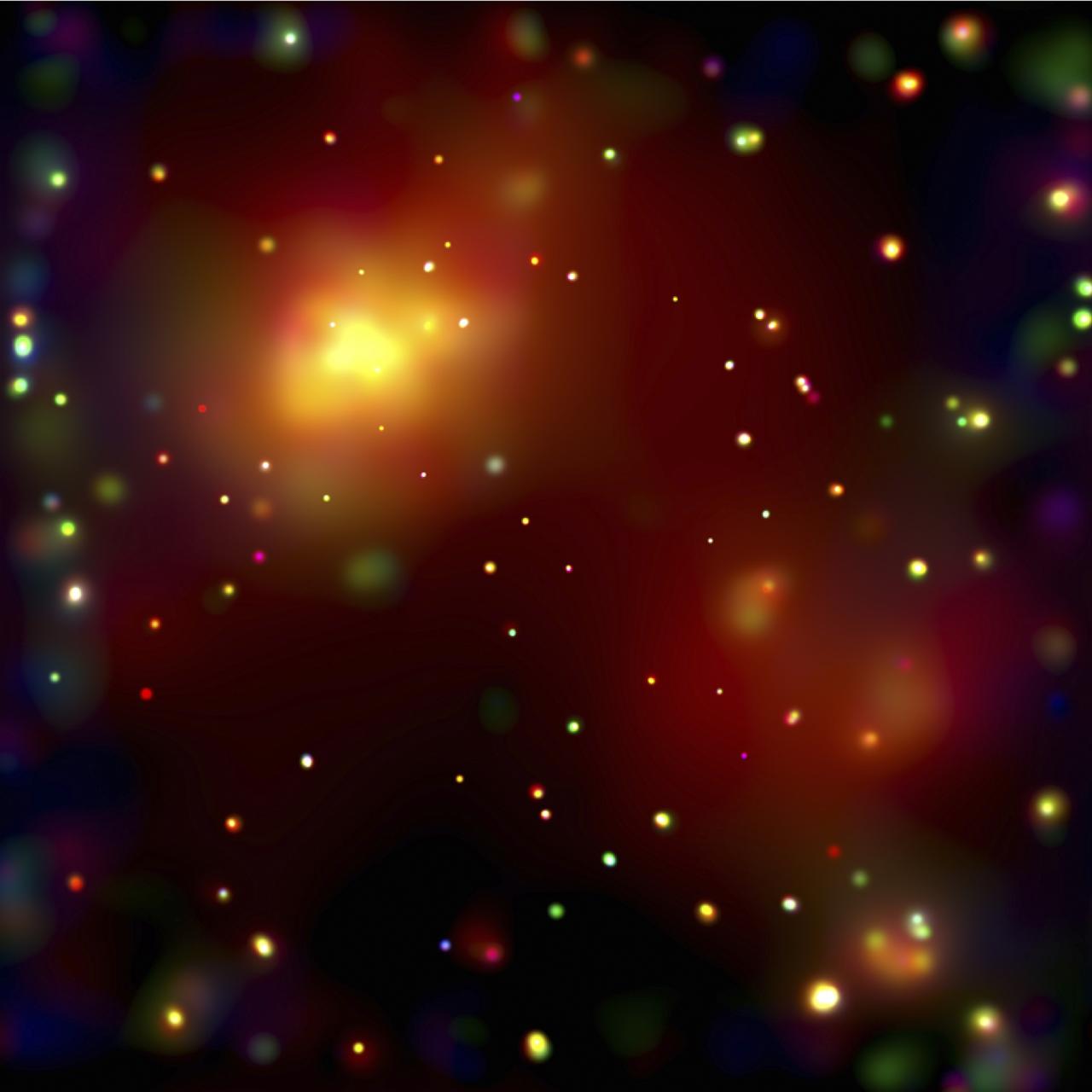
The Astronomy Picture of the Day for September 17, 2026 highlights what NASA describes as a treasure chest inside the Carina Nebula — a reference to the extraordinary density of young, luminous stars packed into its core. Multiple star clusters overlap in this region, each born from the same gas cloud at slightly different times. The result, when photographed at the right wavelengths, is a field of glittering points against pillars of glowing gas: light-years of hydrogen and helium sculpted by the radiation pouring out of tens of thousands of newborn suns.
These are stars born within the last few million years — cosmically speaking, yesterday. Some almost certainly host planets forming around them right now. Whether those planets end up with atmospheres, oceans, or anything more is a question the next generation of telescopes is specifically designed to begin answering. The Carina Nebula sits at the centre of that search.
The SkyLens live tracker shows every tracked object in Earth's orbit in real time — from the ISS to active constellations to the oldest debris. For the bigger picture of what's happening in our solar system and beyond, the SkyLens blog covers every major development as it happens.
Can I see the Carina Nebula from Earth tonight?
Yes — but only from the Southern Hemisphere, or from locations south of roughly 30°N latitude. From southern Australia, South America, southern Africa, or the Indian subcontinent, the nebula appears as a faint elongated smudge in Carina on any clear, moonless night. Through binoculars, the nebulosity becomes unmistakable. Through a small telescope, the clustered stars within it begin to resolve individually.
Eta Carinae itself currently sits around visual magnitude 4–5, just at the naked-eye threshold on a dark night — and it has been slowly brightening. Decades from now, or perhaps centuries, it may be impossible to miss. Learn how to find objects in the night sky using the SkyLens tools and star maps.
SkyLens editorial — live CelesTrak + NASA/JPL data (16022 objects)
Related stories