Space Technology · 2026-08-26
Deep Space Network: The New 34-Metre Antenna That Keeps Humanity's Farthest Machines From Going Silent
Right now, a signal is crossing 24 billion kilometres of empty space. It left a spacecraft in 1977. It arrives at Earth already 22 hours old. The machine that sent it runs on 22 watts of power — less than a refrigerator light bulb. And yet, we hear it.
That's only possible because of one thing: the Deep Space Network. And as of this week, it just got stronger.
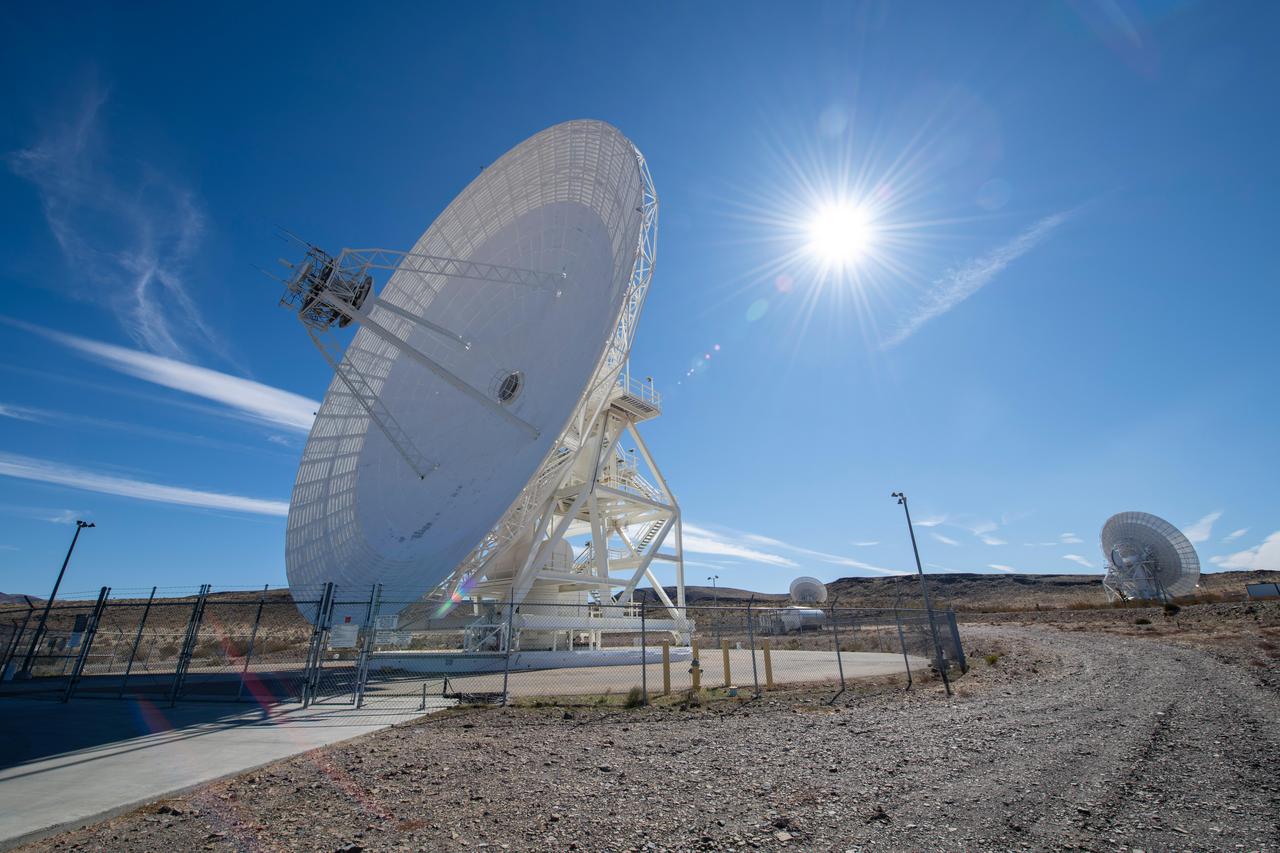
A brand-new 34-metre (114-foot) radio antenna has been added to the Goldstone facility in California's Mojave Desert. It looks like a giant satellite dish aimed at the sky. What it actually is — is humanity's latest attempt to stay connected to the machines we've flung toward the edge of known space.
What is the Deep Space Network?
The Deep Space Network — DSN — is a system of giant radio antennas at three sites around the world: Goldstone in California, outside Madrid in Spain, and near Canberra in Australia. The three sites sit roughly 120 degrees apart, so as Earth rotates, at least one of them always has a clear line of sight to wherever your spacecraft happens to be.
It has been operating since 1963. It guided Apollo 11 to the Moon and listened as Neil Armstrong said his first words on the surface. It received the first images from the Martian surface. It steered Cassini through 13 years of Saturn flybys. And today it is the only way we communicate with Voyager 1 — the farthest human-made object ever launched, now sailing through interstellar space beyond the edge of our solar system.
Those dishes sit in radio-quiet zones — far from cities, far from mobile towers, far from anything that might drown out a whisper from interstellar space. They are, in a very real sense, the most important antennae ever built.
Why does the Deep Space Network need more antennas?
Here's the part nobody is talking about. The DSN was designed for a handful of missions at a time. Right now it's handling more simultaneous deep-space spacecraft than at any point in its 60-year history — and the queue is only getting longer.
Europa Clipper is en route to Jupiter. Both Voyagers are in interstellar space, each demanding regular check-ins. New Horizons is drifting past Pluto in the Kuiper Belt. The James Webb Space Telescope sends enormous datasets from 1.5 million kilometres away. Artemis missions are ramping up. China is launching its own deep-space programme. And every one of those missions competes for precious antenna time.
The DSN has been publicly described as oversubscribed. Mission teams have had to compete for antenna slots. Some science operations have been scaled back — not because scientists didn't want the data, but because there weren't enough ears to hear it. The new Goldstone dish is a direct answer to that bottleneck.
How far can the Deep Space Network actually reach?
This is where it becomes hard to believe.
Voyager 1 is currently about 24 billion kilometres from Earth. If you drove a car at motorway speed, it would take roughly 26 million years to get there. A signal travelling at the speed of light still takes more than 22 hours — one way. When you send a command to Voyager, you wait 44 hours to know if it worked.
Signal travel time — one way:
Voyager transmits on 22 watts — roughly the power of a desk lamp. By the time that signal crosses 24 billion kilometres and arrives at a DSN dish on Earth, it has spread so thin that its power level is approximately 10⁻¹⁶ watts.
That's a hundred femtowatts. You would need to collect that signal continuously for three billion years to charge a single AA battery.
And the DSN hears it clearly enough to pull real scientific data from it.
Is the Deep Space Network only used for Voyager?
Far from it. The DSN is the backbone of almost every major space mission humanity has ever run. It confirmed Cassini's final Saturn plunge in 2017. It received humanity's first close-up images of Pluto in 2015. Every image of a gas giant's rings, every rover selfie from Mars, every detection of a distant moon — it all travelled home through these three clusters of dishes in a California desert, the plains outside Madrid, and the hills near Canberra.
You can actually watch it happen. NASA's DSN Now dashboard shows which dishes are pointing at which spacecraft in real time. It's oddly moving — these giant machines, quietly listening, never sleeping, rotating slowly as the Earth turns beneath them. Want to understand what else is orbiting above your head right now? The SkyLens live tracker shows every tracked satellite in real time, while the DSN handles the ones too far away to appear on any map.
What does the new 34-metre antenna actually change?
The new Goldstone dish won't make headlines the way a Mars landing does. But its impact could be just as meaningful — because it multiplies what science the existing missions can actually return.
Here's the analogy. You've sent the most expensive scientific instrument ever built to photograph the moons of Jupiter. The instrument is working perfectly. But you can only download the data a few hours per day because every antenna is already booked. Adding a new dish is like getting a gigabit connection after years of dial-up. Suddenly all that data — all that science — flows home.
This is the unglamorous work that makes the glamorous work possible. Explore more about the infrastructure behind space exploration on the SkyLens learn page, or read more stories like this on the SkyLens blog.
Why should you care about a dish in the desert?
Here's what nobody tells you about the Deep Space Network: it is entirely irreplaceable. There is no backup. There is no private version being quietly built by anyone.
No company has the economic incentive to build something like this — the returns only make sense if you have an entire space agency's worth of missions to justify it. If the DSN went dark tomorrow, we would lose contact with Voyager. We would lose Europa Clipper. We would lose New Horizons. Billion-dollar spacecraft would keep flying — in silence — with no way to send their discoveries home.
Every image of Jupiter's storms. Every reading from interstellar space. Every measurement from the outer solar system. It all comes home through a dish in a desert, catching a whisper from 24 billion kilometres away.
The new antenna is not just an engineering upgrade. It's a commitment — that however far we send our machines, we will still be listening when they call back.
SkyLens editorial — live CelesTrak + NASA/JPL data (16106 objects)
Related stories