Science · 2026-08-25
Faint Young Sun Paradox: NASA's New Studies Reveal How a Dimmer, Stormier Ancient Star Made Earth Habitable
Four billion years ago, the Sun was 30% dimmer than it is today. Earth, by every calculation, should have been frozen solid — a white marble drifting through space with no liquid water, no complex chemistry, no path to life. Instead, geological evidence shows warm oceans. Ancient zircon crystals. Running rivers. The chemistry of early biology.
For fifty years, this mismatch has haunted planetary science. Scientists called it the Faint Young Sun Paradox — one of the deepest unsolved puzzles in our understanding of how life-bearing planets form. Two new NASA-funded studies, published this week, just took the most credible shot yet at solving it. And the answer changes how we think about life everywhere in the universe.
What is the Faint Young Sun Paradox?
The Faint Young Sun Paradox is the scientific name for a profound contradiction: roughly 4 billion years ago, the Sun produced about 70% of the energy it produces today — but Earth's geological record from that same era shows unmistakable signs of liquid water. By the basic physics of how solar radiation warms a planet, early Earth should have been locked in a global deep freeze.
It wasn't. Something kept it warm. The question is what.
First described by Carl Sagan and George Mullen back in 1972, the paradox has resisted clean resolution for over fifty years. Proposed solutions — extra greenhouse gases, lower cloud cover, reduced albedo from less exposed land — each explain part of the picture but never quite close the gap. The new NASA-funded research takes a different approach entirely: it looks at the Sun itself, not just the planet.
What was the young Sun actually like?
Here's what makes this story stranger than the paradox itself. The young Sun wasn't just dimmer. It was wild.
A star's rotational speed decreases over its lifetime as magnetic braking gradually slows it down. Four billion years ago, the Sun was spinning roughly five times faster than it does today. That faster spin drove an intensely powerful magnetic field — which drove intense solar flares. Not the kind that occasionally disrupt GPS signals today. Events potentially 100 to 1,000 times more powerful, occurring with far greater frequency.
The solar wind — the continuous stream of charged particles the Sun blasts outward — was also dramatically more intense. Some models estimate it was up to 1,000 times denser than today's solar wind. That stream of high-energy particles was hammering early Earth's upper atmosphere constantly, for hundreds of millions of years.
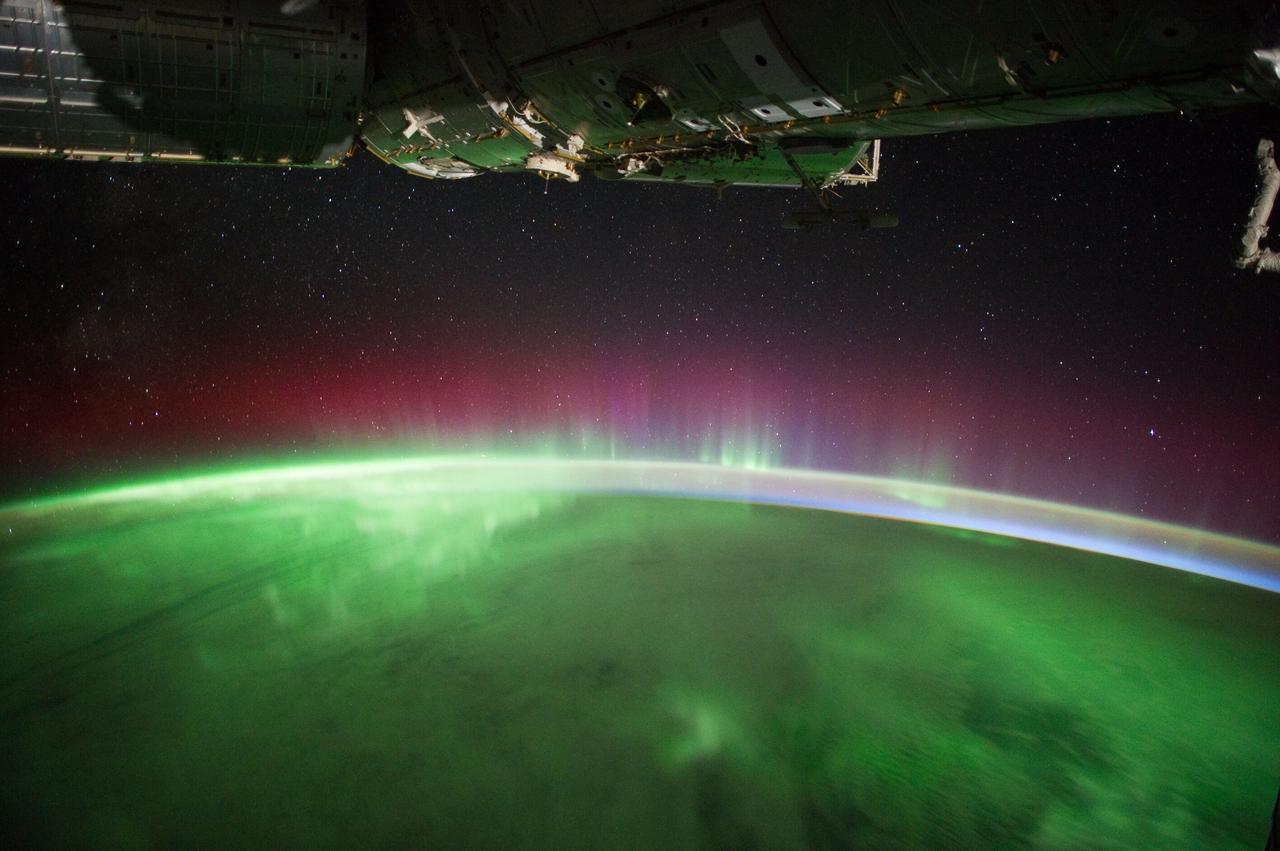
This is the piece that matters. That intense radiation bombardment — ultraviolet, X-ray, energetic particles — wasn't only destructive. The new research suggests it may have been generative.
What did the new NASA studies find?
The two NASA-funded studies examine how ancient events in the Sun's history may have directly influenced Earth's early habitability. The core hypothesis: the Sun's own turbulent early life — its faster spin, fiercer radiation, more intense magnetic storms — may have driven the atmospheric chemistry that kept early Earth warm enough for life to begin.
Specifically, researchers are examining how high-energy solar radiation could have powered photochemical reactions in early Earth's atmosphere, producing greenhouse gases — including methane and other warming molecules — that compensated for the reduced solar heat. Think of it as the young Sun essentially manufacturing its own warming blanket for a planet it was heating less efficiently.
To be fair: NASA describes these as findings about how ancient solar events may have helped create conditions for life — not a closed case. The Faint Young Sun Paradox has resisted definitive resolution for half a century, and these studies add important new evidence rather than a final answer. The mechanisms proposed are plausible and testable. They are not yet proven.
Why does Mars make this so unsettling?
Mars makes this story hauntingly concrete.
Four billion years ago, Mars also had liquid water. River channels. A thicker atmosphere. Possibly the conditions for life. Then, around 3.5 to 4 billion years ago, Mars lost its global magnetic field — its shield against the solar wind. Without that protection, the intense solar wind of the young, wild Sun gradually stripped Mars's atmosphere away, particle by particle, over hundreds of millions of years.
NASA's MAVEN mission has measured this stripping process happening in slow motion right now, even with today's much weaker solar wind. In the young Sun's wilder era, the effect would have been catastrophic.
Earth survived because Earth maintained its magnetic field. Mars didn't. The difference between a living planet and a dead one — between oceans and dust — may come down to whether a planet could hold its magnetic shield across billions of years of stellar bombardment. That is not a comfortable thought.
You can explore Earth's magnetic environment and orbital structure in SkyLens's interactive guides — and see exactly how thin the protected shell around our planet really is.
Does this change how we search for alien life?
Yes. Dramatically.
The classic model for a habitable zone is purely about distance from a star — the Goldilocks band where liquid water can exist on a planet's surface. But the Faint Young Sun Paradox reveals that habitability is far more complex. A planet in the right zone around the wrong kind of young star might get its atmosphere stripped in the first billion years. A planet around an intensely active young star might get its greenhouse gases manufactured by that star's own radiation.
This means the history of a star matters as much as its current output. When astronomers scan the 5,000+ confirmed exoplanets for signs of life, they now need to factor in: how wild was this star in its youth? What did it do to its planets' early atmospheres? Did it strip them, or did it seed them?
Is our Sun unusual compared to other stars?
Compared to many stars, the Sun is relatively calm and stable in its middle age. But many of the most common stars in the galaxy — red dwarfs — remain tidally locked, flare-prone, and magnetically intense for billions of years longer than our Sun was in its wild phase. Whether planets around those stars can survive that sustained punishment long enough to develop life is one of the biggest open questions in astrobiology.
The new NASA research suggests that early stellar intensity might not always be a dealbreaker. Under the right planetary conditions — the right atmosphere, the right magnetic field, the right chemistry — a star's wild youth could actually help build habitability rather than destroy it. That's a remarkable reframe with implications for billions of star systems we haven't yet closely examined.
What comes next in the research?
The next steps involve detailed atmospheric modelling — simulating early Earth's chemistry under the young Sun's radiation, testing whether the proposed photochemical greenhouse mechanisms could actually produce sufficient warming to close the temperature gap. Observations from active missions, including instruments studying young star-planet systems, will provide real-world data on how active young stars interact with planetary atmospheres in real time.
The Faint Young Sun Paradox may not be fully closed yet. But for the first time in decades, scientists are looking at the Sun itself — not just the planet — as part of the answer. And the implication is profound: Earth's habitability may have been a collaboration between a wild young star and a geologically lucky planet.
That raises one final question that the papers don't answer. If the young Sun's own storms helped manufacture the conditions for life here — what's happening right now, around other wild young stars, on other rocky planets we haven't looked at yet?
Want to explore more about how stars, orbits, and cosmic forces shape life on Earth? Read more space stories on SkyLens, or check the orbital and space environment guides to see how Earth's magnetic field protects everything inside it — including you.
SkyLens editorial — live CelesTrak + NASA/JPL data (16106 objects)
Related stories