Space Mysteries · 2026-08-13
Something Is Firing Mystery Signals From Billions of Light-Years Away. They Last a Millisecond. They Outshine Entire Galaxies. Scientists Call Them Fast Radio Bursts — and Have No Idea What's Causing Them.
The most powerful explosions in the universe are over before you can blink
Right now, somewhere billions of light-years across the cosmos, something just detonated a burst of radio energy so intense it briefly outshone every star in its entire galaxy combined.
It lasted one millisecond.
Then silence.
Nobody knows what caused it. Nobody saw it coming. And it happened again an hour later — somewhere else, just as far away, just as powerful, just as inexplicable.
These are Fast Radio Bursts. They're real. They're among the most energetic events in the observable universe. And after nearly two decades of searching, the best minds in astrophysics will tell you the same thing: we don't fully understand what's making them.
We almost missed them entirely
The first Fast Radio Burst wasn't discovered live. It was found buried in six-year-old archived data.
In 2007, astrophysicist Duncan Lorimer was reviewing old recordings from the Parkes radio telescope in Australia when he spotted something that shouldn't exist: a spike of radio energy so brilliant it saturated the detector — then vanished. The timestamp read July 24, 2001. Nobody had been watching the screen when it happened.
The burst lasted 5 milliseconds. The source was 3 billion light-years away. The signal had been traveling since before complex life existed on Earth. And in those 5 milliseconds, it released the equivalent of what our sun outputs over three full days.
Scientists were skeptical. Maybe it was instrument noise. Maybe a passing satellite. Maybe a terrestrial radar bleed. It took years of follow-up detections — from multiple telescopes, across multiple continents — to confirm the uncomfortable truth: these things are real, they're extragalactic, and they're happening constantly.
The machine built to hear them
In 2018, something unusual came online in the mountains of British Columbia. The Canadian Hydrogen Intensity Mapping Experiment — CHIME — looks like no other telescope ever built. No dish. No moving parts. Just four enormous half-pipe reflectors, each 100 metres wide, lying flat on a hillside, scanning the entire northern sky every single day.
CHIME was designed to map ancient hydrogen gas from the early universe. But it accidentally became the most powerful FRB-hunting instrument in history.
In its first year, CHIME detected more Fast Radio Bursts than all previous telescopes combined. Now it logs roughly one per day. The catalog is growing faster than scientists can fully analyse it.
Then one of them did the impossible
Most FRBs fire once and disappear. That made sense, theoretically. An explosion. A collision. A catastrophic death event. The source is destroyed. One flash. Done.
Then FRB 20121102A came back.
The same source. Same location. Firing again. Then again. Then hundreds of times — sometimes several bursts per minute, then months of silence, then erupting once more like something waking up. Theorists who had just settled on "catastrophic one-time event" had to throw out their models. Whatever this object was, it was surviving. And it had a pulse.
The source was eventually pinned to a dwarf galaxy 3 billion light-years away, surrounded by an unusually dense cloud of magnetized plasma. Nothing in the existing catalog of known astrophysical phenomena explained the combination. It had been missed by every model.
If you want to go deeper on unexplained signals from space, the SkyLens learn section has a full breakdown of the history — from Parkes to CHIME to SKA.
Then one fired from inside our own galaxy
April 28, 2020. An FRB was detected — but this one was different.
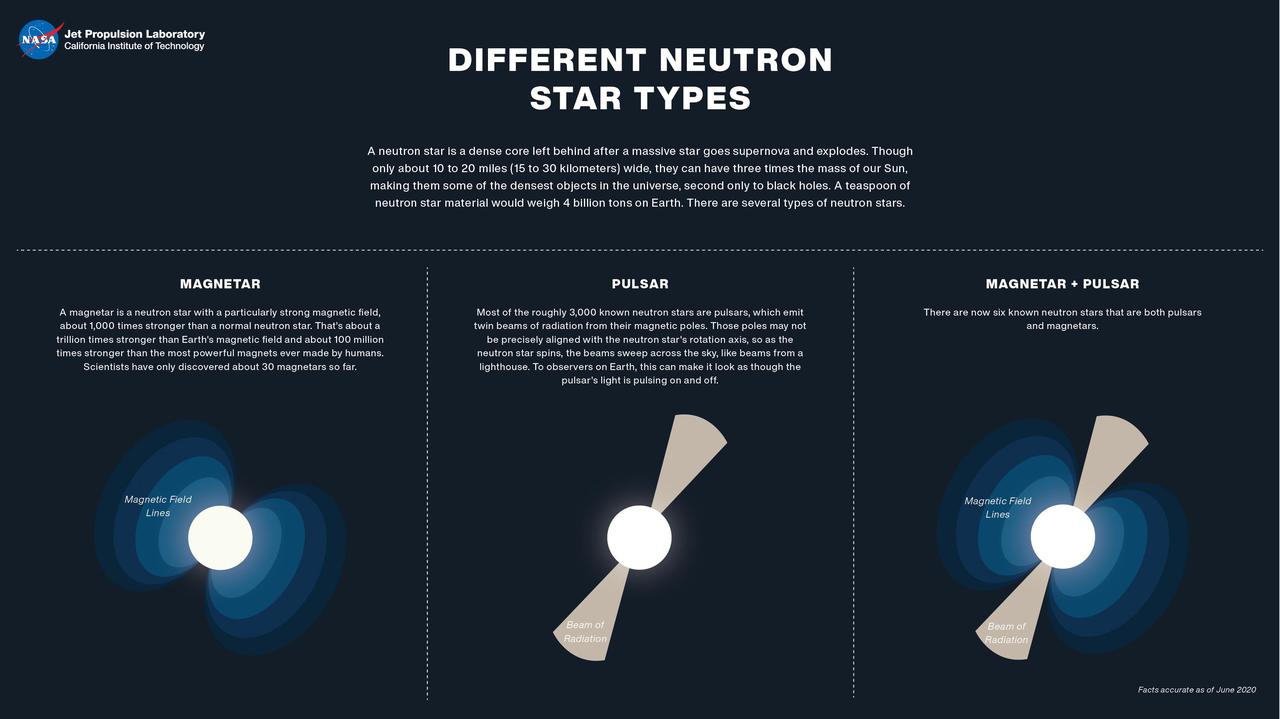
It came from inside the Milky Way. Just 30,000 light-years away. And it was traced to a known, catalogued object: a magnetar called SGR 1935+2154 — a neutron star so dense a teaspoon of it weighs a billion tonnes, wrapped in a magnetic field one trillion times stronger than Earth's.
This was the closest thing to a smoking gun the field had ever produced. Magnetars — the crushed remnants of dead stars — are known to produce violent outbursts. Here was one, in our own galaxy, generating an FRB-like signal for the first time ever observed.
Case closed?
Not quite. The galactic burst was 1,000 times less energetic than a typical extragalactic FRB. If magnetars are responsible for the ones we detect from billions of light-years away, those magnetars would need to be unimaginably more powerful than anything observed in the Milky Way. Possibly more extreme than current physics comfortably allows.
The theory nobody wants to say out loud
Most astrophysicists will tell you magnetars are the leading candidate. Some variation involving colliding neutron stars, or black hole-neutron star mergers, or exotic relics from the Big Bang called cosmic strings, rounds out the serious proposals.
But there's a quieter conversation happening at the edge of the field.
Harvard astrophysicist Avi Loeb — who has argued publicly that the interstellar object Oumuamua showed signs of artificial origin — has formally listed repeating Fast Radio Bursts among phenomena worth examining as potential technosignatures. The repetition patterns. The dispersion characteristics. The energy scales. He's not alone: SETI researchers have systematically analysed repeating FRBs for embedded signal structure.
No structure was found.
To be clear: the overwhelming scientific consensus is that astrophysical explanations are far more likely. Magnetars are real, are violent enough in principle, and are the most rational explanation on the table. But "in principle" and "confirmed" are separated by a gap — and that gap is where the mystery lives.
The next chapter is already being built
The Square Kilometre Array — SKA — is a radio telescope so large it spans two continents. Its dishes are spread across Australia and South Africa, with a combined collecting area of one square kilometre. When it reaches full operation this decade, it will be 50 times more sensitive than any radio telescope currently operating.
The goal isn't just to find more FRBs. It's to catch one close enough and bright enough to study simultaneously across every wavelength — radio, X-ray, optical, gamma ray — all at once. A full multi-messenger portrait of the event in real time. That observation would either confirm the magnetar model or shatter it entirely.
Either outcome rewrites something fundamental about how the universe works.
Until the SKA comes fully online, CHIME keeps listening. Every day, another flash arrives from somewhere incomprehensibly far away. Something that was — for one millisecond — brighter than an entire galaxy worth of stars.
Then nothing.
The universe has been doing this the entire time we've existed. We only started noticing in 2007. The question isn't whether there's more to discover. The question is whether we'll understand what we're looking at when we finally find it close enough to study.
SkyLens editorial — live CelesTrak + NASA/JPL data (16106 objects)
Related stories