Space Weather · 2026-06-24
A Solar Storm Knocked Out Quebec's Power in 90 Seconds. The AI Boom Just Made America's Grid Far More Vulnerable.
The timing could not be worse
Right now, somewhere in the American Southwest, a data center the size of several city blocks is being wired into the power grid. It will consume somewhere between 100 and 500 megawatts of electricity — more than the entire city of Buffalo uses on a summer afternoon. There are dozens more like it under construction. Hundreds more planned.
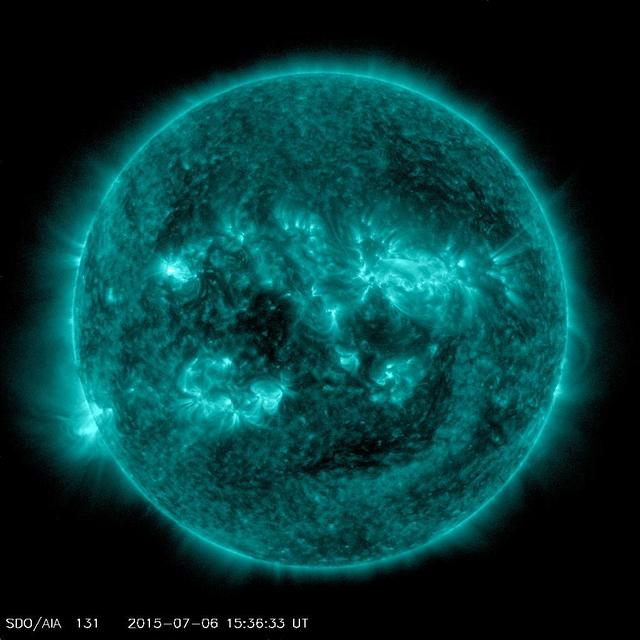
And at this exact moment in 2026, the Sun is at the peak of Solar Cycle 25. The most active phase of its 11-year magnetic cycle. Solar flares and coronal mass ejections — billion-ton plasma clouds fired at 3 million kilometers per hour — are erupting more frequently than at any point in two decades.
A new report from SpaceNews this week put it plainly: America's electric grid is entering a period of unprecedented strain. The question space weather scientists have been quietly asking for years just became urgent. What happens to an overstressed grid when the Sun decides to take a swing?
What a coronal mass ejection actually does on the ground
The Sun is constantly exhaling — a thin stream of charged particles called the solar wind flows outward at all times. But during a major flare, the Sun doesn't exhale. It coughs. Hard.
A coronal mass ejection (CME) fires a magnetized cloud of plasma directly into space. When it reaches Earth, it compresses our magnetic field and induces enormous electrical currents in anything long and conductive on the surface below. Power lines. Undersea cables. Natural gas pipelines. The longer the conductor, the bigger the current.
Those induced currents — geomagnetically induced currents, or GICs — are essentially unwanted DC electricity flowing through infrastructure designed for AC. High-voltage transformers cannot handle this. They overheat. They fail. Some melt from the inside.
The worst part: large power transformers are not off-the-shelf items. They are custom-built, they weigh hundreds of tons, and global manufacturing lead times run 12 to 18 months. You cannot order spares from Amazon the morning after a storm.
March 13, 1989 — the storm that actually happened
In the early morning hours of March 13, 1989, a moderate-sized CME slammed into Earth's magnetic field after a massive solar flare six days earlier. The effects were immediate.
Hydro-Québec's power grid went from normal operation to total collapse in less than 90 seconds. Six million people lost electricity. The blackout lasted nine hours. Transformers failed across the northeastern United States. Auroras were visible as far south as Florida and Texas — not because it was beautiful, but because Earth's magnetic field was being hammered from above.
1989 was not a worst-case scenario. Not even close.
The Carrington Event, named after British astronomer Richard Carrington who observed the solar flare directly, released energy equivalent to roughly 10 billion atomic bombs. In 1859, the most sophisticated electrical infrastructure on Earth was the telegraph. Operators reported that their machines worked even when disconnected from the battery — purely from induced current in the wires. Some of those wires caught fire.
A Carrington-scale event hitting today's grid has been estimated by Lloyd's of London and the Cambridge Centre for Risk Studies to cause between $0.6 trillion and $2.6 trillion in damage in the United States alone, with recovery times measured in years, not weeks.
Why AI makes this a fundamentally different threat
Here is where the modern story diverges from all the historical ones.
When the Quebec blackout happened in 1989, power demand was distributed. Cities consumed electricity, but the heaviest loads were spread across thousands of factories, offices, and homes. A grid failure hurt everyone, but no single node consumed more power than a moderate industrial plant.
AI data centers changed this calculus entirely.
A hyperscale facility training a large language model can draw 500 megawatts — the equivalent power consumption of 400,000 average American homes — from a single point of connection. Multiple facilities are clustered in the same geographic regions because land and power agreements are concentrated. Virginia's data center corridor, Northern Nevada, the Arizona desert.
This creates a new vulnerability: not just widespread damage, but concentrated damage. A geomagnetic storm that takes down transformers serving a cluster of AI data centers doesn't just inconvenience users — it destroys infrastructure that supports financial systems, logistics networks, and communications simultaneously. The failure modes compound faster than any previous grid stress scenario planners had modeled.
Our only warning system: a single satellite at L1
DSCOVR — the Deep Space Climate Observatory — sits at the gravitational balance point between Earth and the Sun called L1, roughly 1.5 million kilometers away. It continuously monitors the solar wind: measuring particle density, speed, and magnetic field direction.
When a CME reaches DSCOVR, scientists on the ground know the storm is real and can measure its orientation. If the magnetic field is pointing southward — the worst configuration for Earth — that's the moment forecasters issue their highest-level alerts.
The problem: DSCOVR is only about 15 to 45 minutes ahead of Earth. That is your warning window. That is all of it. In 15 to 45 minutes, grid operators must decide whether to reduce power loads, isolate vulnerable transformers, and begin controlled shutdowns of sections of the grid — or take their chances.
For a single power plant, that's workable. For a grid simultaneously serving tens of millions of homes, hundreds of industrial facilities, and dozens of 500-megawatt AI data centers? The coordination problem is staggering.
You can follow active satellite monitoring — including the DSCOVR satellite's current position — on the SkyLens live tracker.
Solar Cycle 25: right now, the Sun is at its most active
Solar activity follows an approximately 11-year cycle between periods of quiet (solar minimum) and high activity (solar maximum). Solar Cycle 25 peaked around late 2025 and remains in its elevated phase through 2026 — right now.
NOAA's Space Weather Prediction Center has recorded multiple X-class flares this cycle — the highest category, capable of causing radio blackouts on Earth's sunlit side. Several significant CMEs have already caused G3-level (severe) geomagnetic storms in 2024 and 2025.
None of those storms hit the grid squarely. The geometry has to be right — the CME has to be directed at Earth, and the magnetic field has to be oriented southward when it arrives. Most CMEs miss or arrive in configurations that cause aurorae but not catastrophic GICs.
But we are rolling the dice more frequently right now than we have in two decades. And the grid beneath us has never held more concentrated, hard-to-replace critical infrastructure than it does today.
What actually happens in the hours after a major strike
This is not hypothetical modeling. Emergency planners have walked through the scenario. Here is the sequence that concerns them most.
A large CME arrives with southward magnetic orientation. DSCOVR confirms the threat at T-minus 30 minutes. Grid operators begin emergency procedures — but the coordination required to gracefully shed load across an interconnected continental grid in 30 minutes has never been successfully practiced at scale. Some transformers absorb GICs before they can be isolated. Several fail simultaneously in the same regional corridor.
The cascade begins. When large transformers fail, the grid loses voltage stability. Automated protection systems — designed to prevent damage — begin disconnecting sections. Other sections overload. The disconnections spread faster than operators can respond.
AI data centers, drawing enormous power from the same substations as urban populations, either go dark immediately or survive on backup diesel generators for 24 to 72 hours — until diesel runs out. Some have contractual fuel priority. Many do not.
Recovery requires replacing failed transformers. That takes months per unit. The grid returns to full function on a rolling timeline measured in years, not weeks.
To be fair: this is the worst-case scenario. Grid planners have modeled less severe outcomes, and hardening efforts over the past decade have reduced some of the most critical single-point vulnerabilities. But researchers quoted in the SpaceNews analysis argue those hardening efforts have not kept pace with the scale of new AI infrastructure being wired into the same system.
What's being done — and what isn't
NOAA's Space Weather Prediction Center operates continuously. The US government's National Space Weather Strategy, updated most recently in 2024, outlines roles for federal agencies during a major solar event. Some utilities have installed GIC-blocking capacitors on high-voltage transformers — particularly in regions with high geomagnetic exposure like the upper Midwest and New England.
The physics of space weather is increasingly well-understood. Forecasting has improved. The 48-hour CME arrival prediction window is now reasonably reliable for direction, if not always for magnetic orientation on arrival.
What the SpaceNews analysis highlights — and what researchers have flagged in congressional testimony as recently as 2025 — is a gap between the pace of space weather hardening and the pace of new critical infrastructure being built without hardening requirements baked in. There is currently no federal regulation mandating that AI data centers be built to withstand extended grid outages, or that the transformers serving them be GIC-protected.
That may change. The Federal Energy Regulatory Commission has discussed expanding GIC mitigation requirements. Some industry groups are pushing for data center grid independence — essentially treating large AI facilities the way hospitals are treated, with hardened backup systems that can sustain operations through grid disruption.
But that work is happening in parallel with a construction boom. The data centers are going up faster than the policy is moving.
For a deeper look at how satellites and space infrastructure interact with Earth's systems, explore the SkyLens learning center — or check the full blog archive for more on space weather and planetary defense.
SkyLens editorial — live CelesTrak + NASA/JPL data (15822 objects)
Related stories