Space Science · 2026-10-11
IceCube Neutrino Observatory: The Cubic Kilometre of Antarctic Ice Hunting Ghost Particles From Dying Stars
Right now, 65 trillion ghost particles are passing through your body. Every second. Without slowing down. Without asking permission.
These are neutrinos — the most antisocial particles in the universe. They pass through the entire Earth the way light passes through glass. A wall of lead a light-year thick — that's 9.5 trillion kilometres of solid metal — would barely slow most of them down.
So scientists buried a trap at the bottom of the world. A cubic kilometre of ancient Antarctic ice, studded with over 5,000 light sensors, waiting in the dark for a collision that happens roughly once in every 100 billion attempts. And what it's caught is rewriting everything we thought we knew about the universe's most violent machines.
Today's NASA Astronomy Picture of the Day (October 11, 2026) is dedicated to this extraordinary instrument: the IceCube Neutrino Observatory. Here's the story behind it — and what it's finding.
What exactly is a neutrino?
Neutrinos are subatomic particles — almost massless, carrying no electric charge. That absence of charge is the key to everything. Without it, they don't interact with matter the way protons or electrons do. They don't bounce off atoms. They don't get absorbed. The entire planet Earth is, to a neutrino, essentially empty space.
The Sun produces them in staggering quantities. Every nuclear fusion reaction in its core sends neutrinos flooding outward in every direction. Eight minutes later, they reach Earth. And pass straight through. Through the crust. Through the mantle. Through the molten iron core. Through you. Out the other side. Without leaving a single trace.
So how do you catch something that doesn't want to be caught?
Why is IceCube buried in Antarctic ice?
You need mass. Enormous mass. Because neutrinos interact so rarely, the only way to detect them is to put so much material in their path that eventually — very occasionally — one collides with a molecule and produces a faint blue flash. Put enough detectors around that flash, triangulate its direction, and you can trace the neutrino back toward its source.
Antarctic ice, compressed over hundreds of thousands of years to depths below 1.5 kilometres, is one of the clearest natural substances on Earth. Almost no bubbles. Almost no impurities. When a neutrino interaction produces secondary particles moving faster than light travels through ice (in ice, light slows to 75% of its vacuum speed — particles can exceed that local speed limit without violating Einstein), those particles emit a blue glow called Cherenkov radiation. In Antarctic ice, that glow travels with almost no distortion for hundreds of metres.
Between 2005 and 2010, the IceCube collaboration — funded by the US National Science Foundation and led by the University of Wisconsin–Madison — drilled 86 holes into the Antarctic ice sheet. Each hole 2.5 kilometres deep. Each just 60 centimetres wide. Into each they lowered a string of light sensors. 5,160 sensors in total, spanning a full cubic kilometre of ancient ice. The whole structure weighs approximately one billion tonnes.
What has IceCube actually discovered?
In 2013, IceCube made history. It detected neutrinos with energies so extreme they couldn't have come from the Sun. These were cosmic neutrinos — particles that had crossed the universe, born in events so violent they dwarf anything humans have ever built. The team named the first two detections "Bert" and "Ernie." Whimsical names for particles that had been travelling for billions of years before arriving in a block of Antarctic ice.
Then in 2022 came the result that rewrote textbooks. IceCube traced a stream of high-energy neutrinos back to a specific galaxy: NGC 1068 — also known as the Squid Galaxy — about 47 million light-years away. At its centre sits a supermassive black hole actively consuming gas. That turbulent, superheated environment is a natural particle accelerator, hurling protons to energies no human machine can match, generating neutrinos as a byproduct.
To be fair: the NGC 1068 finding is a statistical association — a significant excess of neutrinos arriving from that direction in the sky. IceCube's scientists describe it as compelling evidence rather than absolute proof. The signal is real and growing stronger with each year of data, but it is not a pinpoint beam we've isolated. As the detector accumulates more events, the picture is sharpening.
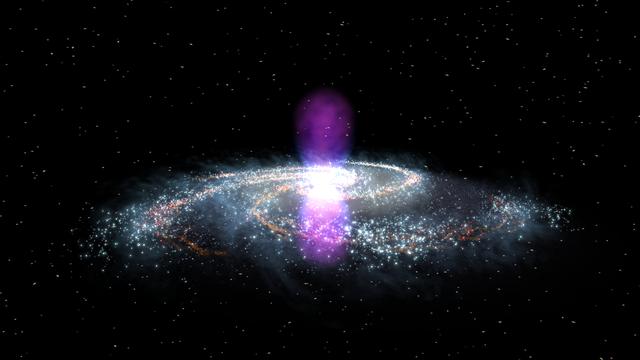
Then in 2023, IceCube published another landmark result: a diffuse glow of neutrinos coming from the Milky Way itself. Not from one source — from everywhere along the galactic plane. Thousands of old supernovae, pulsars, and cosmic-ray collisions, all quietly radiating ghost particles across millions of years. Our galaxy has been sending messages in neutrinos for as long as it has existed. Including toward Earth. Including through you, right now, as you read this.
Supernova SN 1987A: 24 neutrinos detected from a stellar death 168,000 light-years away — 3 hours before visible light arrived. First confirmed neutrino observation from a stellar collapse.
IceCube construction completed. One cubic kilometre of instrumented ice, 2.5 km underground. The largest neutrino detector ever built.
IceCube detects high-energy neutrinos from outside our solar system for the first time. Named "Bert" and "Ernie." Multi-messenger astronomy officially begins.
First confirmed extragalactic neutrino source — a supermassive black hole 47 million light-years away. Confirms that cosmic monster accelerators exist.
IceCube detects diffuse neutrino emission from across our own galaxy. The entire galactic plane is a source. Our home galaxy has been broadcasting ghost particles for billions of years.
How did neutrinos warn us a star was dying — 3 hours before we saw anything?
On February 23, 1987, a massive star in the Large Magellanic Cloud — a small galaxy orbiting the Milky Way — ended its life. Its iron core collapsed in less than one second. In that instant, the core released more energy than the Sun will emit across its entire 10-billion-year life.
99% of that energy left as neutrinos.
Detectors in Japan, the United States, and Russia registered a burst of 24 neutrinos — from a stellar explosion 168,000 light-years away. Twenty-four. And they arrived three hours before the star became visible in any telescope on Earth.
Neutrinos escape from the collapsing stellar core instantly — before the shockwave has even reached the surface of the star, before a single photon has broken free. Light has to fight its way through thousands of kilometres of stellar material. The neutrinos were announcing a star's death while the star still looked alive to every telescope in the world.
IceCube is now watching for the next galactic supernova. If a star within the Milky Way collapses, IceCube would detect millions of neutrino interactions within seconds — an alarm so clear that astronomers worldwide would know a star was dying before any telescope could point at it. Explore more about what's watching the sky at the SkyLens science pages.
What does IceCube see that telescopes can't?
Every traditional telescope — optical, radio, X-ray, infrared — detects photons. Light. Light can be blocked, scattered, and absorbed. Many of the universe's most extreme environments are hidden behind thick clouds of gas and dust that photons simply cannot penetrate. The heart of NGC 1068's black hole, for instance, is shrouded behind a dense ring of gas. Its light is partially blocked. Its neutrinos are not.
IceCube is, in effect, a telescope that sees through walls. A billion-tonne ice detector that receives signals from the very centres of active black holes, from the cores of dying stars, from places where no photon has ever escaped. Scientists call this "multi-messenger astronomy" — combining light, gravitational waves (from LIGO), and neutrinos to assemble a complete picture of the universe's most violent corners. See what's currently overhead on the SkyLens live tracker.
What's next for IceCube?
The collaboration is already planning IceCube-Gen2 — an expanded detector targeting roughly eight cubic kilometres of Antarctic ice, nearly ten times the current volume. More sensors, deeper holes, and a surface array to catch cosmic-ray air showers. The goal: trace dozens of cosmic neutrino sources, and build the first neutrino map of the universe's most powerful particle accelerators.
A nearer-term upgrade — the IceCube Upgrade — adds denser sensor strings to the existing detector for lower-energy neutrinos. The target: neutrino oscillations, the phenomenon where a neutrino changes from one type to another as it travels. Why does that matter? Because neutrino oscillations are one of the very few confirmed observations that cannot be fully explained by the Standard Model of particle physics as currently written. Every time IceCube detects one, it's poking at a crack in humanity's best theory of how matter works.
Ghost particles from dying stars. A billion-tonne ice trap at the bottom of the world. Messages from a hungry black hole 47 million light-years away. And the possibility — growing stronger every year — that these particles are pointing us toward physics the textbooks haven't written yet.
Space has always had a habit of humbling us. IceCube is one of the instruments doing the humbling. For more stories like this, visit the SkyLens blog.
SkyLens editorial — live CelesTrak + NASA/JPL data (15968 objects)
Related stories