Space Science · 2026-10-09
Titan's Methane Lakes: Saturn's Moon Is Raining Methane Right Now — and NASA's Nuclear Helicopter Will Land There in 2034
It rains on Titan. Not water — methane. Liquid hydrocarbons pour from orange clouds, carve rivers through black ice, and empty into seas the size of the Caspian. Saturn's largest moon has more liquid on its surface than all of Earth's oceans combined. None of it is water. And somewhere 1.2 billion kilometres from where you're sitting, it is raining there right now.
This isn't a hypothetical planet from a sci-fi novel. This is a real moon orbiting a planet you can see on a clear night. And in 2034, NASA lands a helicopter on it.
What makes Titan so eerily Earth-like?
Titan is Saturn's largest moon — bigger than the planet Mercury. It's the only moon in our solar system with a thick atmosphere, and the only world besides Earth known to have stable liquid pooled on its surface. That atmosphere is mostly nitrogen, like ours. The pressure at Titan's surface is about 1.5 times what you feel standing outside right now. If you teleported there in a warm suit, the pressure would feel almost normal. Then you'd freeze to death in seconds. It's -179°C.
But the real story is the chemistry. Sunlight and Saturn's radiation constantly hammer Titan's atmosphere, triggering chain reactions and raining down complex organic molecules — tholins, benzene, hydrogen cyanide, amino acid precursors — that coat the surface in a reddish-orange haze. These are the same building blocks scientists believe existed on early Earth, before life started. Titan is essentially running a slow-motion replay of Earth's prebiotic chemistry. At a temperature that would kill anything alive today.
How big are Titan's methane seas?
Kraken Mare — Titan's largest sea — covers roughly 400,000 square kilometres. That's bigger than the Caspian Sea, Earth's largest lake. Ligeia Mare adds another 126,000 square kilometres. These aren't shallow puddles. Cassini's radar data suggests depths exceeding 300 metres in places. Hundreds of smaller methane lakes dot the polar regions, some appearing and disappearing with Titan's 29-year seasons — seasonal lakes, on another world, that behave nothing like anything in our experience of "lakes."
The Huygens probe — released by Cassini, parachuting through Titan's atmosphere — descended for 72 minutes on January 14, 2005. When it reached the surface, it kept transmitting: cameras, spectrometers, a microphone. ESA later released a reconstruction of what Huygens heard. Wind. The crunch of a methane-soaked surface. Scientists described a rocky floodplain, a few degrees below what would have been Titan's ancient shoreline. It was the most distant landing in human history at that time. We've done it once. For 72 minutes. Twenty-one years ago.
Could there be life on Titan?
Possibly — but not the kind you're imagining. Earth life needs liquid water. Titan has none on its surface. But in 2015, NASA researchers published a theoretical model of an organism that could survive in liquid methane the way Earth life uses water — breathing hydrogen, metabolising acetylene as fuel. Nobody found this life. Nobody proved it can exist. But here's what made the scientific community pay close attention: Cassini data showed hydrogen near Titan's surface was depleted in ways the known chemistry alone couldn't cleanly explain. Acetylene was depleted too.
To be fair: planetary scientists have cautious, non-biological explanations for both anomalies — unusual mineral absorption, unexpected surface reactions. Neither anomaly has been definitively resolved. That's the honest scientific position. This is an open question, not a discovery. The anomalies might mean nothing. But they are precisely the kind of thing that justifies sending a nuclear helicopter 1.2 billion kilometres to go and look properly.
What is the Dragonfly mission and when does it reach Titan?
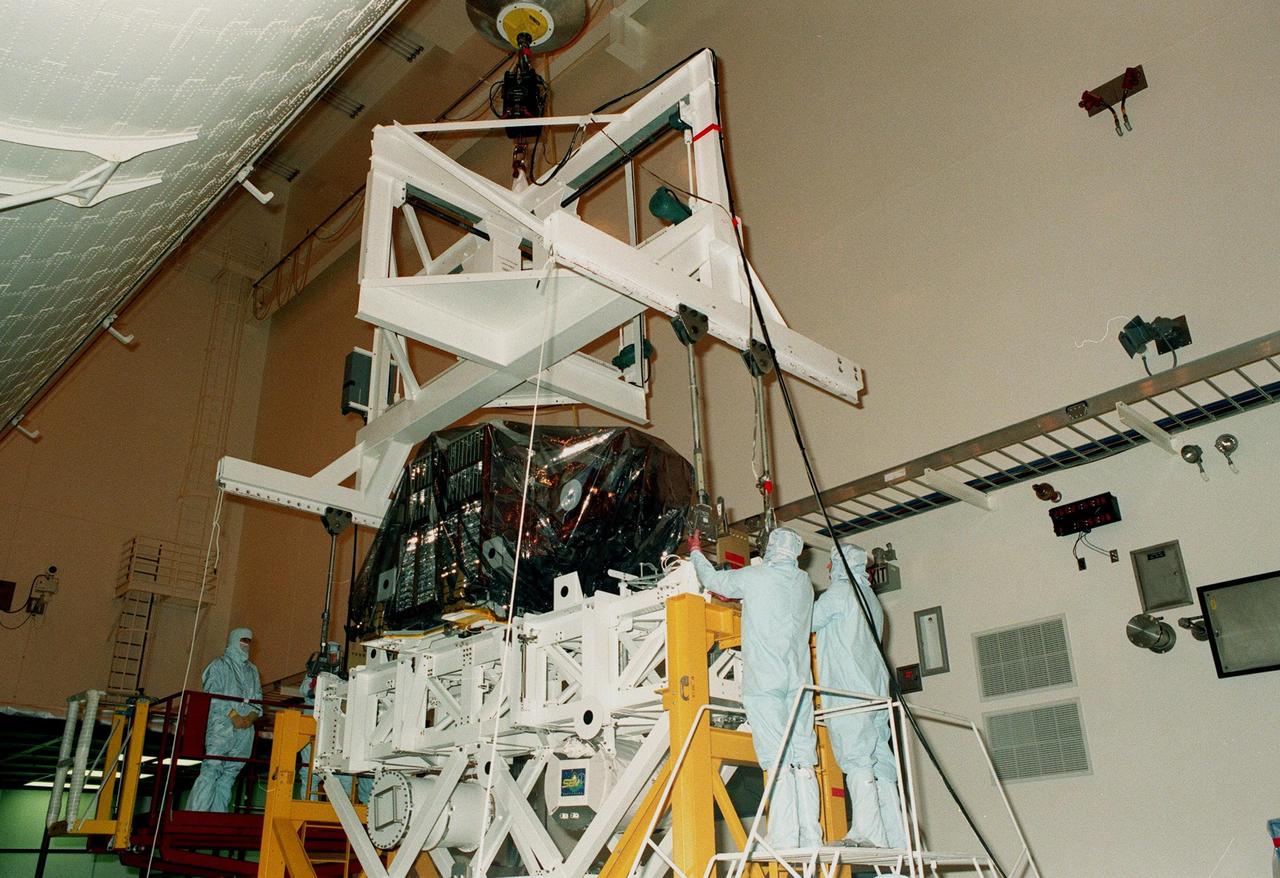
Dragonfly is NASA's answer: a nuclear-powered rotorcraft — imagine a car-sized drone running on a plutonium battery — designed to fly across Titan's surface, hopping up to 8 kilometres per flight. Titan's low gravity (one-seventh of Earth's) and thick atmosphere make aerial exploration there surprisingly efficient. One nuclear charge gives it 45-minute flight windows. Over its planned mission, Dragonfly will cover more ground than every Mars rover combined has ever driven. Not because it's faster. Because Titan lets it fly.
The target is Selk impact crater. When a meteorite strikes Titan, the heat briefly melts the ice — creating a temporary pool of liquid water that mixes directly with the complex organics lying on the surface. For a few thousand years, you have water and organic chemistry in contact. That's the combination where life begins on Earth. Dragonfly arrives at Selk in 2034 to read the chemical record that event left behind — analysing samples on-site and transmitting results home at the speed of light, with an 80-minute wait each way.
Does Titan have a liquid water ocean?
Almost certainly — underground. Cassini's gravity measurements suggest a subsurface liquid water ocean sits beneath Titan's icy crust, possibly mixed with ammonia. It may be 100 kilometres deep, sealed from the surface by thick ice. The interior stays warm through Saturn's constant tidal flexing and slow radioactive decay from the core. That ocean has almost certainly been there for billions of years. In complete darkness. Cut off from everything above.
That gives Titan two separate potential habitats. Europa has a buried ocean. Enceladus has a buried ocean and vents shooting it into space. But only Titan has a buried ocean and a surface soaked in complex organic chemistry sitting directly above it. No other moon offers both at once. If the surface chemistry ever found a path down, or the ocean ever vented upward, the two environments could have met. Repeatedly. For billions of years.
Cassini ended its mission in 2017 by deliberately plunging into Saturn — to ensure no risk of contaminating Titan or Enceladus with Earth microbes. Thirteen years of data. A list of questions longer than the answers. That's where we are. Dragonfly is the follow-up that question deserves. You can follow every active NASA mission and track spacecraft in Earth orbit right now at the SkyLens live tracker. For a deeper look at what humanity is sending into the solar system and why, visit the learn section. And for the strangest unexplained observations from orbit and beyond, the UAP files archive is a good rabbit hole.
SkyLens editorial — live CelesTrak + NASA/JPL data (15968 objects)
Related stories